
Discovered Materials is on a quest for innovative chips through AI challenges.
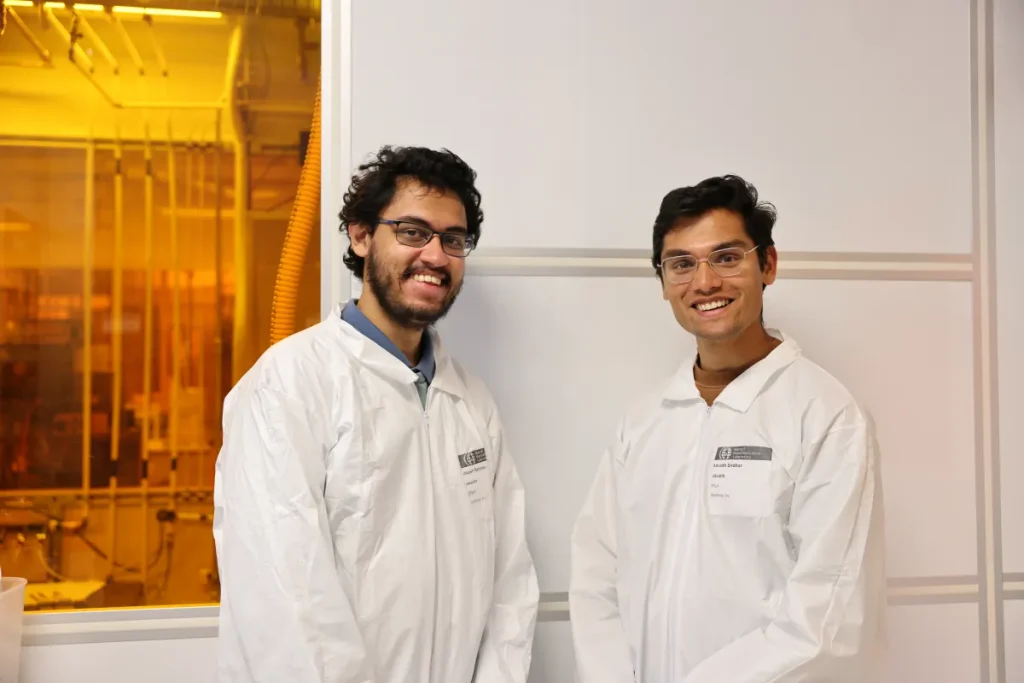
Image Credits:Discovered Materials / Discovered Materials
Tackling Heat Issues in AI Workloads
As artificial intelligence (AI) becomes increasingly integral to modern technology, one significant challenge persists: the excessive heat generated by AI workloads. This overheating problem is a primary contributor to the high electricity consumption and cooling requirements of data centers. In response to this self-inflicted challenge, innovative entrepreneurs are leveraging AI to find solutions.
Introducing Discovered Materials
Discovered Materials is a startup that aims to address this issue by employing swarms of AI agents to identify new materials capable of enhancing the efficiency of integrated circuits (ICs). Recently, they secured a $9 million seed funding round led by Lightspeed India Partners, following their participation in Y Combinator. Additional investment has come from Peak XV Partners and notable angel investors, including Paul Graham, Gokul Rajaram, and Thariq Shihipar.
Founders’ Expertise: Advaith Sridhar and Akash Ramdas
The brainchild behind Discovered Materials is a collaborative effort between founders Advaith Sridhar and Akash Ramdas. Ramdas brings his expertise in materials science, acquired during his doctoral studies at Stanford University, while Sridhar contributes his experience in AI from roles at Persona AI and Luma Labs.
Together, they have developed a sophisticated software pipeline that employs Anthropic AI models to generate potential material candidates. This pipeline then utilizes foundational physics models to conduct simulations, confirming the viability of these candidates for semiconductor applications.
Enhanced Prediction Capabilities
During his PhD, Ramdas was limited to generating about 20 material guesses daily. However, with the deployment of their AI agents working continuously in the cloud, Sridhar explains, “We’re able to do thousands of guesses a day now, exploring research directions based on inputs from Ramdas.”
Discovered Materials recently showcased hundreds of newly discovered materials and introduced their “Material Discovery Bench,” a tool designed to monitor the challenge of material discovery.
Competing in the Material Discovery Landscape
The startup operates in a competitive field, with companies like MatNex, SandboxAQ, and CuspAI also pursuing similar objectives. Discovered Materials stands apart by concentrating on thermal issues related to semiconductor materials. While the startup has already identified several candidates that exhibit properties comparable to existing materials used by leading chipmakers, they remain tight-lipped about specific details for now.
Navigating the Engineering Challenges
One significant hurdle in material discovery lies in the engineering trade-offs. Finding a material that reduces heat generation or improves heat dissipation can present challenges in manufacturability or compromise electrical characteristics. Hemant Mohapatra, the Lightspeed partner who led the seed round, highlighted the complexity, stating, “It’s a bit of playing whack-a-mole with atomic structures. A material is only useful if all properties align perfectly, making this a fascinating search problem.”
Future of Material Discovery
Mohapatra foresees a future where the ability to predict new substances becomes a commodity as models improve. Nevertheless, Discovered Materials distinguishes itself through Ramdas’ extensive knowledge and their capacity to conduct rapid experiments and validate new material candidates. This capability is crucial, given that both founders have already achieved promising results with various new materials.
When valuable candidates are identified, Sridhar asserts that the company will seek to patent the applications of these materials in graphics processing units (GPUs) or the methods for manufacturing chips from them. He optimistically states that the company aims to have patent-worthy materials within the next year.
The Commercial Landscape of AI-Discovered Materials
Despite the excitement surrounding AI-generated materials and drugs, tangible commercial impacts remain elusive. The most notable example of an AI-discovered pharmaceutical is Insilico Medicine’s Renterosib, recognized as the first generative AI drug advancing to a Phase II clinical trial. On the materials front, promising candidates exist — such as MatNex’s rare-earth-free permanent magnets and innovations from Panasonic and Citrine Informatics. Yet, none have been deployed on a large scale.
Bottlenecks in AI Material Science
As technology progresses, Mohapatra asserts that the struggle in AI materials science isn’t about generating more candidates but revolves around “filtering them correctly and synthesizing them,” which he identifies as the real bottleneck in the process.
The Reality of Lab Work
Sridhar believes that Discovered Materials’ exclusive data and expertise will position them favorably against well-funded laboratories. However, he acknowledges the inherent challenges: “A lot of this will involve actually going into wet labs and making things. And this is a process that cannot be expedited.”
Conclusion
Discovered Materials represents a promising venture into the intersection of AI and materials science, targeting the critical thermal issues presented by AI workloads. With a strong focus on efficiency and a solid foundation in scientific expertise, the startup aims to pave the way for innovative solutions in semiconductor materials. As they navigate the complexities of material discovery and manufacturing, their journey will be closely watched by the tech community and beyond. The future of efficient, AI-driven materials could redefine the landscape of integrated circuits and data center operations, aligning the needs of technology with the principles of sustainability.
Thanks for reading. Please let us know your thoughts and ideas in the comment section down below.
Source link
#Discovered #Materials #playing #whackamole #hunt #cooler #chips
About The Author