Inherent’s AI ‘Teammate’ Surpasses Anthropic and OpenAI in Research Replication Tasks
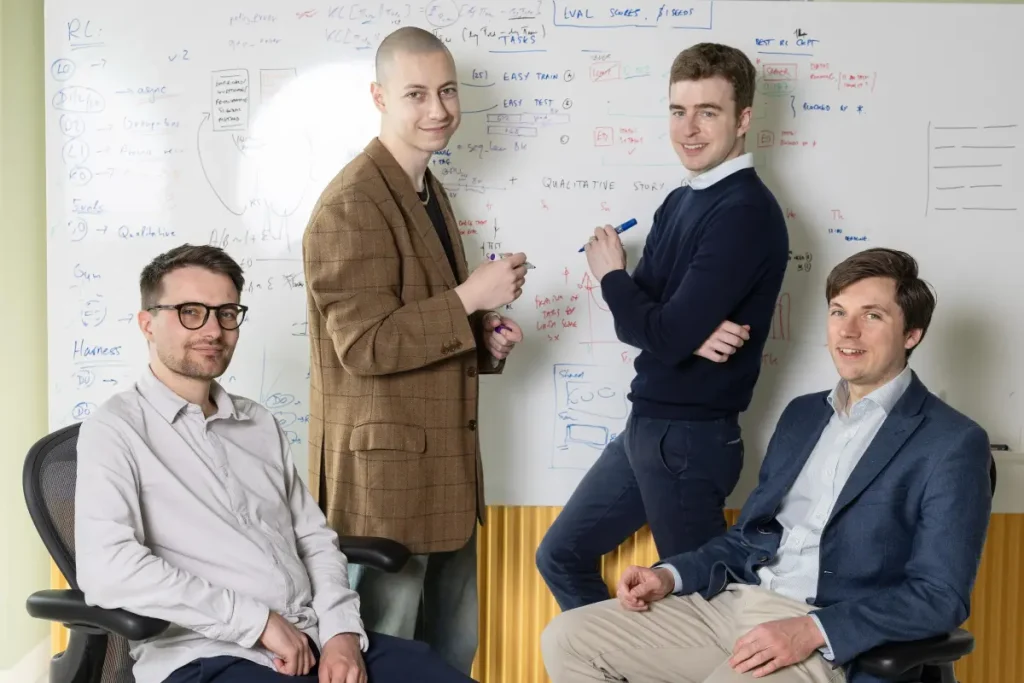
Image Credits:Anna Gordon
Inherent AI: A New Player in the AI Landscape
Inherent, a London-based AI laboratory founded by alumni of Google DeepMind, has recently announced that its AI agent, Faraday, has outperformed significantly larger models developed by competitors Anthropic and OpenAI, while operating at a fraction of their size.
Promising Beginnings
Although Inherent has not garnered as much attention as some of its better-funded rivals, it is starting to showcase its innovative technology shortly after securing a $50 million seed funding round. Faraday is its latest AI agent, designed to replicate published scientific findings independently, without any prior hints. This task, while seemingly straightforward, is a crucial exercise in scientific training and lays the groundwork for Inherent’s ambitious goals.
According to Edward Hughes, co-founder and chief scientist at Inherent, many PhD students begin their academic journeys by replicating existing results. “Many PhD students actually start by doing this,” Hughes mentioned, indicating that the work isn’t just a novelty but rooted in the training of scientists.
Achievements and Goals
Interestingly, Hughes emphasized that beating larger AI models was not the primary aim; rather, the journey and methodology of creating Faraday are what resonated most with the team. “What was most interesting to us about this was not so much the result of beating those frontier agents…but the way we went about building this,” he stated.
Faraday’s performance is particularly noteworthy when compared to Anthropic’s Claude Opus 4.8 and OpenAI’s GPT-5.5, both of which are massive, industry-standard AI systems. Faraday operates on the relatively compact Qwen 3.6 model, consisting of only 27 billion parameters. This metric serves as a rough indicator of a model’s complexity and associated training costs.
However, Inherent’s criteria for success transcend mere accuracy. The team aimed to imbue Faraday with what they call “research taste”—an innate sense of which experiments are valuable and how to design them effectively. Achieving this level of sophistication involves many challenges, especially in teaching an AI system something as nuanced as intuition.
Reinforcement Learning Approach
To tackle this challenge, Inherent has adopted reinforcement learning, a training method that rewards positive outcomes rather than dictating rigid rules. Unlike many competitors who focus on traditional narratives of scientific process, Inherent believes that this reward-based framework will enable a more comprehensive generalization for its long-term goal—developing AI capable of advancing knowledge across various scientific domains.
Hughes summarizes their vision: “We’re always guided by that north star of building an AI scientist agent and imbuing our agents with taste.” This philosophy has also influenced the company’s decisions on what not to develop. Instead of creating their own coding tools, they utilized OpenAI’s GPT-5.5 Codex, mirroring how human scientists typically leverage existing resources.
Fostering Collaboration and Curiosity
Inherent aims to differentiate itself by fostering an AI that doesn’t just validate existing beliefs but encourages inquiry and exploration. “We don’t want agents that simply tell users what they want to hear,” Hughes explained. His ideal AI teammate would return with the results of various experiments, sharing new insights rather than simply reaffirming the status quo.
This collaborative ethos is echoed in Inherent’s organizational structure. The company operates with a small, in-person team located in King’s Cross, a neighborhood in London that has transformed into a prominent AI hub, partly due to the presence of Google DeepMind. “We believe that London is the place to be,” Hughes stated, reinforcing their commitment to the local AI community.
Challenges and Opportunities in Talent Recruitment
Despite the excitement surrounding London’s rich talent pool in AI, Hughes has voiced concerns about “garden leave,” a common practice in the UK where departing employees are prevented from joining competing firms for a certain period after leaving their positions. This contrasts sharply with the more flexible environment seen in the U.S., where researchers often transition more freely, providing American startups with an earlier advantage in hiring.
“It’s a personal view rather than a company view, but I was affected by the garden leave problem,” Hughes remarked, highlighting that it posed hurdles in his own career transitions.
After navigating through this constraint, Hughes co-founded Inherent alongside two fellow DeepMind alumni and a fourth co-founder. The company is not resting on its laurels; it aims to expand its workforce to between 20 and 25 employees by the end of the year, indicating a robust growth trajectory.
Attracting Talent from DeepMind
With the evolving dynamics at DeepMind, including changes in leadership that have left some employees unsettled, Inherent’s planned expansion could present a promising opportunity for talent looking to join a different environment.
Conclusion
Inherent’s journey is just beginning, but its focus on creating sophisticated AI agents capable of not only replicating science but also pioneering new discoveries makes it a startup worth watching. With its innovative methodologies and commitment to collaboration, Inherent positions itself as a potential game-changer in the AI field. As the company gains traction, it will be interesting to see how it continues to develop its ambitious vision of building AI that can truly think and act like a scientist.
Thanks for reading. Please let us know your thoughts and ideas in the comment section down below.
Source link
#Inherent #founded #DeepMind #alumni #teammate #outperformed #Anthropic #OpenAI #replicating #research
About The Author