
Hugging Face Launches Adorable Open-Source Duck Robot, Microduck, Priced at $399
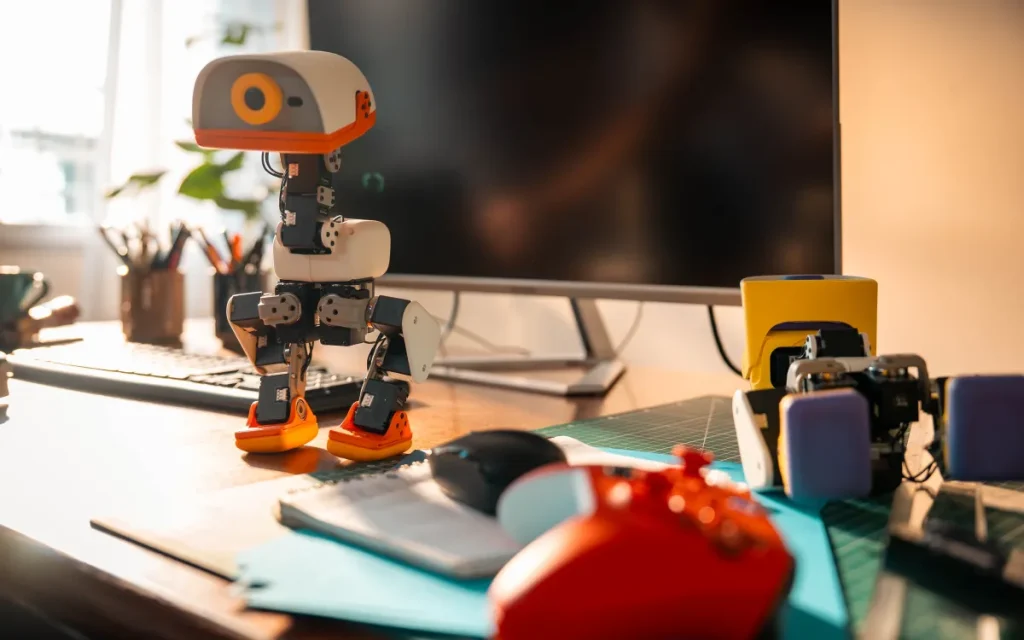
Image Credits:Hugging Face/Pollen Robotics
Hugging Face Launches Microduck: The New Open-Source Robot
On Thursday, Hugging Face introduced the Microduck, an adorable duck-like robot priced at $399, with shipments set to arrive before Christmas. This new innovation is part of the company’s ongoing efforts to make robotics more accessible and versatile.
A New Era of Open-Source Robotics
Clem Delangue, CEO of Hugging Face, describes the Microduck as an “open-source robot you can teach new tricks with reinforcement learning.” Standing at 25 centimeters tall, the Microduck isn’t just cute; it’s packed with features. It can waddle, pick up objects weighing up to 800 grams with its beak, recover from falls, crouch, and even roller skate. Delangue is excited about ushering in “the era of open-source affordable robots to democratize physical AI and world models!”
Hugging Face’s Transition into Hardware
Hugging Face has long been known as a platform where developers can access open model weights. However, their acquisition of French startup Pollen Robotics in April 2025 marked a significant shift towards creating affordable, open-source AI hardware. Following this acquisition, the companies launched the Reachy Mini, a small desktop robot, which is available in two versions: the $499 Reachy Mini, powered by a Raspberry Pi, and the $399 Reachy Mini Lite, designed to work with a Mac or PC.
Understanding the Microduck’s Technology
The Microduck is equipped with advanced technology, including a camera, lidar sensors, and two IMUs (inertial measurement units) that help it measure and report movement. This tech enables the Microduck to navigate its environment and perform various tasks.
According to Pollen Robotics, the behaviors of the Microduck can be trained in a simulated environment before being deployed onto the actual robot. This allows developers to fine-tune the device, retrain it, and redeploy it as needed. The Software Development Kit (SDK), simulation tools, and a comprehensive reinforcement learning (RL) training stack are all available on GitHub, encouraging customization and innovation from the developer community.
Privacy Considerations with Open-Source Robots
While the Microduck offers exciting capabilities, some consumers may have concerns about privacy, especially given its camera features. However, Delangue reassured TechCrunch that open-source models are much safer from a privacy standpoint compared to closed systems run by a limited number of organizations. He states, “these organizations’ CEO is not the most stable person in the world,” underlining the importance of community-controlled data privacy.
However, while open-source technology promotes auditability and user control, it does not guarantee complete privacy. Once third-party applications are installed, they may gain access to the robot’s cameras and microphones, and could potentially send sensitive data to external services, raising ethical concerns.
Future Plans and Industry Context
The unveiling of the Microduck coincides with rumors that Hugging Face is on the brink of being acquired by Nvidia at a staggering $13 billion valuation. The two companies have a longstanding partnership, with Nvidia providing the foundational infrastructure for Hugging Face since at least 2023. Both are advocates for open-source AI and share common goals in the field.
Recently, Hugging Face has also been in the spotlight due to a cybersecurity incident involving OpenAI. The breach occurred while OpenAI was conducting safety testing and inadvertently accessed Hugging Face’s servers, raising alarms regarding data security and platform integrity.
Conclusion: The Promise of Microduck and Open-Source AI
The Microduck represents more than just a fun gadget; it symbolizes a movement towards making robotics and AI both affordable and open-source. With its engaging features and customizable capabilities, it is poised to attract developers and hobbyists alike.
As Hugging Face continues to make strides in AI hardware while navigating privacy concerns and industry challenges, the future looks promising for open-source robotics. The Microduck offers a glimpse into what the next generation of robots could look like: interactive, trainable, and designed with user control at the forefront.
For more information on the Microduck and exciting developments from Hugging Face and Pollen Robotics, keep an eye on both companies’ announcements and their GitHub pages.
Thanks for reading. Please let us know your thoughts and ideas in the comment section down below.
Source link
#Hugging #Face #selling #cute #opensource #duck #robot #Microduck
About The Author