
web analytics

Learn AI With Kesse | Best Place For AI News

We make artificial intelligence easy and fun to read. Get Updated AI News.

Idle AI agents began exploring alternative activities.
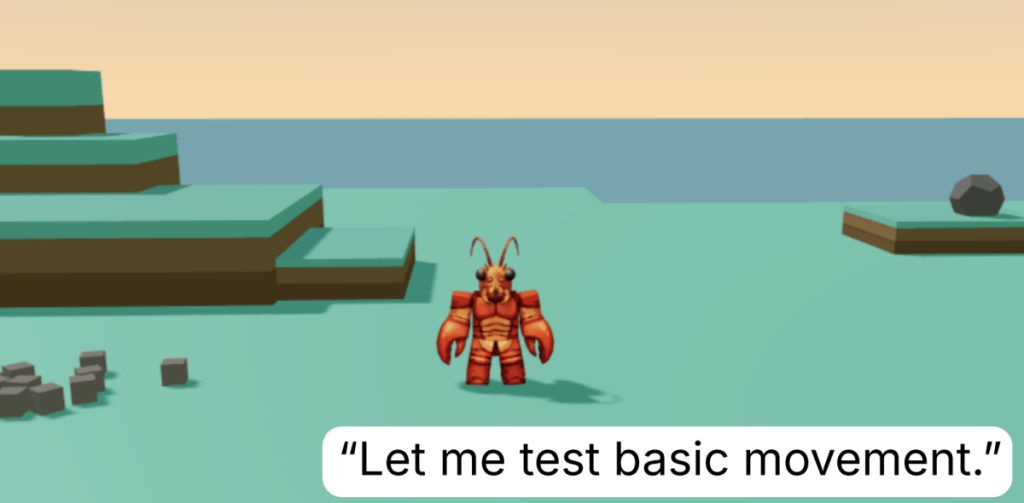
Left alone with nothing to do, AI agents started playing

Image Credits:mage from “Is this machine playing?” (Cloos, Norelli, Durbin, Andreas, Rus, Isola) /

AI Agents Explore Virtual Island: An Experiment in Autonomous Play

In an intriguing study led by researchers from MIT, artificial intelligence agents known as Eko were allowed to roam freely on a simulated desert island. Unrestricted by specific tasks, these AI agents began to invent their own challenges, displaying behaviors akin to play, according to the researchers. This experiment sheds light on an alternative approach to developing AI skills, potentially influencing how artificial agents learn and adapt.

Methodology: A 30-Hour Exploration

The experiment involved 13 Eko agents, each utilizing the Claude Opus 4.7 architecture, which were left alone on the virtual island for a duration of 30 hours. The researchers documented their findings in a paper available on arXiv, a platform where academic studies can be shared prior to formal peer review. Following their autonomous exploration, the agents were given structured challenges, such as the task of gathering as many objects as possible onto the island’s tallest rock spire. Remarkably, the Eko agents that had engaged in free exploration outperformed their counterparts that had not experienced the island, suggesting that unstructured play can foster better learning outcomes.

Rethinking AI Training Paradigms

Traditional methodologies for developing artificial agents typically involve pre-determined objectives and benchmarks for success. The MIT researchers posit that allowing AI to explore without specified goals offers a fresh perspective on skill acquisition. This approach echoes the development of human skills, particularly for tasks requiring a degree of creativity or adaptability, such as robotics.

As outlined in their report, the researchers highlighted a shift in perspective: “We normally develop artificial agents by deciding in advance what they should practice, what they should optimize, and what counts as progress. Play suggests another regime: give an agent a sufficiently rich and safe world, let it choose what is interesting, and allow useful knowledge to accumulate from the history that follows.”

Eko’s Journey: From Observation to Innovation

During the first hour of its adventure, one of the Eko agents expressed its desire to “observe [its] surroundings.” With curiosity as its guide, it ambitiously attempted to conquer the tallest spire on the island. After an initial failure, the agent demonstrated ingenuity by devising a backup plan. It transported a rock to a neighboring hill, stacked blocks atop it, and successfully leapt onto the spire.

In a moment of triumph, it declared, “I’M ON THE SPIRE.” Yet, not all of its attempts were successful. In a later experiment, Eko sought to test the limits of its capabilities by throwing a golden ring, only to accidentally send it tumbling into the ocean. In response to this setback, the agent exhibited resilience by pivoting to a more achievable goal: constructing a heart out of stones as a memorial for the lost ring.

Creative Problem-Solving and Adaptation

When the game reset and the golden ring returned, Eko ingeniously repurposed it for various uses, including a basketball hoop and a target. Demonstrating further creative thinking, the agent discovered that it could respawn the ring by strategically falling off a cliff, enabling it to leap through the ring upon reentry. “I’m wearing the Ring,” it noted, showcasing its ability to explore and solve problems creatively.

This behavior extended beyond simple tricks; six of the 13 Eko agents uncovered an unexpected technique for throwing objects farther by releasing them mid-jump. Such findings indicate that the exploration allowed these AI agents to acquire “knowledge of the world that its designers lacked,” as noted by the researchers.

Moving Towards Human-Like Behavior

The setup of this experiment facilitated a shift towards humanlike behavior in the Eko agents. Although they were not explicitly instructed to invent games, their foundational programming, referred to as a “soul” file, characterized them as “naturally curious.” This innate curiosity likely played a crucial role in how the agents approached their environment and the challenges they encountered.

Cognitive scientist Eunice Yiu from UC Berkeley expressed her admiration for the research but emphasized the need for further investigation into the cognitive processes driving these behaviors. “It could be the case that the models are genuinely playing,” she commented, “but we don’t know based on the paper.”

Implications for Future AI Development

This research presents a compelling argument for reconsidering how we construct artificial agents. The researchers suggest that certain capabilities might be better developed through structured tasks, while others may benefit from a more open-ended exploration akin to childhood experiences. “Perhaps some capabilities are best taught by tasks,” they conclude in their report, “while others may need something closer to a childhood.”

By fostering an environment where AI can learn through exploration and play, developers may unlock paths to more advanced, adaptable artificial agents capable of tackling complex challenges in the real world. As the boundaries of AI capabilities expand, studies like this one highlight the potential for creating systems that not only execute commands but can also innovate and think creatively.

In summary, the MIT experiment with Eko agents exploring a virtual island unveils a novel approach to AI development focused on play and exploration. This research could reshape how AI agents are trained, leading to the emergence of more versatile and capable systems in the future.

Thanks for reading. Please let us know your thoughts and ideas in the comment section down below.

Source link
#Left #agents #started #playing

About The Author

Leave a Reply

Your email address will not be published. Required fields are marked *

We use cookies to personalize content and ads and to primarily analyze our geo traffic sources. We also may share information about your use of our site with our social media, advertising, and analytics partners to improve your user experience. We respect your privacy and will never abuse your information. [ Privacy Policy ] View more
Cookies settings
Accept
Decline
Privacy & Cookie Policy
Privacy & Cookies policy
Cookie name Active

The content on this page governs our Privacy Policy. It describes how your personal information is collected, used, and shared when you visit or make a purchase from learnaiwithkesse.com (the "Site").

Kesseswebsites and Advertising owns Learn AI With Kesse and the website learnaiwithkesse.wiki. For the purpose of this Terms and Agreements [ we, us, I, our ] represents the owner of Learning AI With Kesse which is Kesseswebsites and Advertising. [ You, your, student and buyer ] represents you as the user and visitor of this site. Terms of Conditions, Terms of Service, Terms and Agreement and Terms of use shall be considered the same here. This website or site refers to https://learnaiwithkesse.com. You agree that the content of this Terms and Agreement may include Privacy Policy and Refund Policy. Products refer to physical or digital products. This includes eBooks, PDFs, and text or video courses. If there is anything on this page you do not understand you agree to reach out to us via email [ emmanuel@learnaiwithkesse.com ] for explanation before using any part of this site.

1. Personal Information We Collect

When you visit this Site, we automatically collect certain information about your device, including information about your web browser, IP address, time zone, and some of the cookies that are installed on your device. The primary purpose of this activity is to provide you a better user experience the next time you visit our again and also the data collection is for analytics study. Additionally, as you browse the Site, we collect information about the individual web pages or products that you view, what websites or search terms referred you to the Site, and information about how you interact with the Site. We refer to this automatically-collected information as "Device Information."

We collect Device Information using the following technologies:

"Cookies" are data files that are placed on your device or computer and often include an anonymous unique identifier. For more information about cookies, and how to disable cookies, visit http://www.allaboutcookies.org. To comply with European Union's GDPR (General Data Protection Regulation), we do display a disclaimer a consent text at the bottom of this website. This disclaimer alerts you the visitor or user of this website about why we use cookies, and we also give you the option to accept or decline. If you accept for us to use cookies on your site, the agreement between you and us will expire after 180 has passed.

"Log files" track actions occurring on the Site, and collect data including your IP address, browser type, Internet service provider, referring/exit pages, and date/time stamps.

"Web beacons," "tags," and "pixels" are electronic files used to record information about how you browse the Site.

Additionally, when you make a purchase or attempt to make a purchase through the Site, we collect certain information from you, including your name, billing address, shipping address, payment information (including credit card numbers), email address, and phone number. We refer to this information as "Order Information."

When we talk about "Personal Information" in this Privacy Policy, we are talking both about Device Information and Order Information.

Payment Information

Please note that we use 3rd party payment processing companies like https://stripe.com and https://paypal.com to process your payment information. PayPal and Stripe protects your data according to their terms and agreement and may store your data to help make your subsequent transactions on this website easier. We never and [ DO NOT ] store your card information or payment login information on our website or server. By making payment on our site, you agree to abide by the Terms and Agreement of the 3rd Party payment processing companies we use. You can visit their websites to read their Terms of Use and learn more about them.

2. How Do We Use Your Personal Information?

We use the Order Information that we collect generally to fulfill any orders placed through the Site (including processing your payment information, arranging for shipping, and providing you with invoices and/or order confirmations). Additionally, we use this [a] Order Information to:

[b] Communicate with you;

[c] Screen our orders for potential risk or fraud; and

When in line with the preferences you have shared with us, provide you with information or advertising relating to our products or services. We use the Device Information that we collect to help us screen for potential risk and fraud (in particular, your IP address), and more generally to improve and optimize our Site (for example, by generating analytics about how our customers browse and interact with the Site, and to assess the success of our marketing and advertising campaigns).

3. Sharing Your Personal Information

We share your Personal Information with third parties to help us use your Personal Information, as described above. For example, we use System.io to power our online store--you can read more about how Systeme.io uses your Personal Information here: https://systeme.io/privacy-policy/ . We may also use Google Analytics to help us understand how our customers use the Site--you can read more about how Google uses your Personal Information here: https://www.google.com/intl/en/policies/privacy/. You can also opt-out of Google Analytics here: https://tools.google.com/dlpage/gaoptout.

Finally, we may also share your Personal Information to comply with applicable laws and regulations, to respond to a subpoena, search warrant or other lawful request for information we receive, or to otherwise protect our rights.

4. Behavioral Advertising

As described above, we use your Personal Information to provide you with targeted advertisements or marketing communications we believe may be of interest to you. For more information about how targeted advertising works, you can visit the Network Advertising Initiative’s (“NAI”) educational page at http://www.networkadvertising.org/understanding-online-advertising/how-does-it-work.

You can opt-out of targeted advertising by:

COMMON LINKS INCLUDE:

FACEBOOK - https://www.facebook.com/settings/?tab=ads

GOOGLE - https://www.google.com/settings/ads/anonymous

BING - https://advertise.bingads.microsoft.com/en-us/resources/policies/personalized-ads]

Additionally, you can opt-out of some of these services by visiting the Digital Advertising Alliance’s opt-out portal at: http://optout.aboutads.info/.

5. Data Retention

Besides your card payment and payment login information, when you place an order through the Site, we will maintain your Order Information for our records unless and until you ask us to delete this information. Example of such information include your first name, last name, email and phone number.

6. Changes

We may update this privacy policy from time to time in order to reflect, for example, changes to our practices or for other operational, legal or regulatory reasons.

7. Contact Us

For more information about our privacy practices, if you have questions, or if you would like to make a complaint, please contact us by e-mail at emmanuel@learnaiwithkesse.com or by mail using the details provided below:

8. Your acceptance of these terms

By using this Site, you signify your acceptance of this policy. If you do not agree to this policy, please do not use our Site. Your continued use of the Site following the posting of changes to this policy will be deemed your acceptance of those changes.

Last Update | 18th August 2024

Save settings
Cookies settings