
Salesforce CEO Marc Benioff: We’ve Experienced SaaSpocalypse Before—Stay Focused
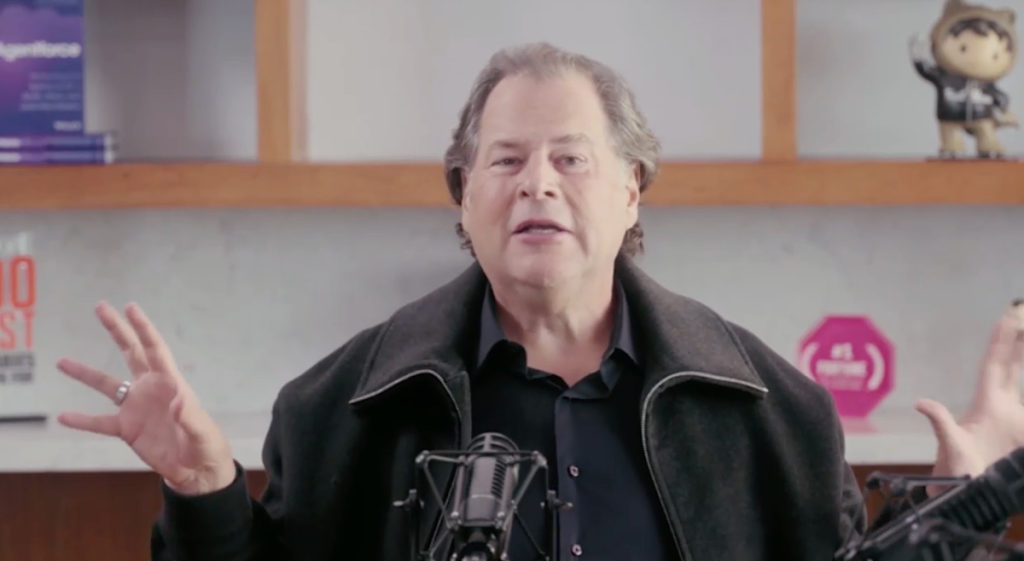
Image Credits:Salesforce earnings call
Salesforce’s Fourth-Quarter Earnings: Demonstrating Resilience in the Face of AI Concerns
On Wednesday, Salesforce made a bold statement during its fourth-quarter earnings announcement, reinforcing to investors that the evolving AI landscape will not spell doom for the company. In a high-stakes climate where Software-as-a-Service (SaaS) stocks are under siege, Salesforce presented robust financial results, demonstrating its commitment to innovation and stability.
Strong Financial Performance
Salesforce reported an impressive revenue of $10.7 billion for the fourth quarter, marking a 13% increase year-over-year. For the entire fiscal year, the company posted revenues totaling $41.5 billion, reflecting a 10% uptick from the previous year. This growth was significantly bolstered by Salesforce’s $8 billion acquisition of data management firm Informatica last May, showcasing the company’s strategic moves to enhance its market position.
In terms of profitability, Salesforce reported a net income of $7.46 billion. Looking forward, the company’s guidance is optimistic, projecting revenues between $45.8 billion and $46.2 billion for the upcoming year—a growth prediction of 10% to 11%. Additionally, Salesforce mentioned its “remaining performance obligation” (RPO) exceeds $72 billion, indicating a strong future revenue stream from existing contracts yet to be fulfilled.
Concerns Over the “SaaSpocalypse”
Despite these impressive numbers, Salesforce faces significant challenges within the SaaS sector. Many investors are worried that the rise of AI agents could undermine traditional business models, leading to what has been dubbed the “SaaSpocalypse.” During the earnings call, CEO Marc Benioff acknowledged these concerns, referencing the term repeatedly to assure investors that Salesforce has weathered similar storms in the past.
Benioff remarked, “If there is a SaaSpocalypse, it may be eaten by the Sasquatch because there are a lot of companies using a lot of SaaS. It just got better with agents.” This statement aimed to highlight the adaptability of SaaS solutions in an evolving technological landscape.
Strategic Moves to Reassure Investors
To further bolster investor confidence, Salesforce introduced several significant initiatives. The company raised its dividend by nearly 6%, increasing it to $0.44 per share. Salesforce also announced a substantial $50 billion share buyback program—an initiative that typically resonates positively with shareholders as it signals financial health and aims to uplift share prices.
In an innovative approach, Salesforce revamped its earnings call format. Combining elements of a podcast, infomercial, and Q&A session, Benioff interviewed three prominent Salesforce customers. These discussions featured the CEOs of SharkNinja, Wyndham Hotels and Resorts, and SaaStr, all of whom expressed strong satisfaction with Salesforce’s AI-driven features. The messaging was clear: existing customers are finding immense value in the company’s innovations.
Introducing Agentic Work Units (AWU)
In another effort to convey its value proposition, Salesforce unveiled a new performance metric known as agentic work units (AWU). Unlike traditional measurements that simply count processing volume “tokens,” AWU assesses whether an AI agent has successfully completed a verifiable task. Salesforce logged a staggering 19 trillion tokens in the last quarter, a figure that, while impressive, may not resonate deeply in the context of enterprise utility.
Patrick Stokes, Salesforce’s president and CMO, explained that while AI can produce creative outputs like poems, such capabilities lack value in a business setting. AWU aims to capture impactful work that adds operational value, thus refining the way success is measured.
Architectural Vision for the Future
Salesforce also laid out its vision for the future of SaaS and AI integration. The company aspires to dominate its own tech stack while positioning AI model creators as essential yet largely unseen components within the ecosystem. This approach is a direct response to fears stirred by the recent release of OpenAI’s enterprise agent, Frontier. OpenAI proposes a framework where SaaS providers act as foundational elements, a structure Salesforce intends to counter with its own comprehensive strategy.
The earnings call illustrated Salesforce’s ambition to solidify its role as a leader in the SaaS space, promising that its innovations will not only withstand the influence of AI but thrive alongside it.
Ceo’s Distinctive Style Boosting Investor Confidence
Adding an extra layer of charisma to the earnings call, Benioff donned a black leather jacket—an intentional homage to Nvidia’s CEO, Jensen Huang, who has thrived in the AI domain. This gesture was emblematic of Salesforce’s ambition to position itself as an innovator amid the competitive AI landscape.
Conclusion
Salesforce’s fourth-quarter earnings report serves as a vital reminder of the company’s resilience and forward-thinking approach in an era fraught with digital transformation. As the SaaS market grapples with emerging AI technologies, Salesforce has confidently conveyed its commitment to evolving alongside these shifts. By introducing strategic initiatives, enhancing customer engagement, and proposing new performance standards, Salesforce showcases not only its current vitality but also its vision for a future intertwined with the advancements of artificial intelligence.
Investors and stakeholders interested in the SaaS space will be watching closely to see if Salesforce can continue to defy the fears surrounding the so-called “SaaSpocalypse” while capitalizing on opportunities that come with innovation.
Thanks for reading. Please let us know your thoughts and ideas in the comment section down below.
Source link
#Salesforce #CEO #Marc #Benioff #isnt #SaaSpocalypse
About The Author