

AI Surprises This Week: OpenAI Garlic, Google Titans, Apple Clara, GPT 5.2, AGI Claims
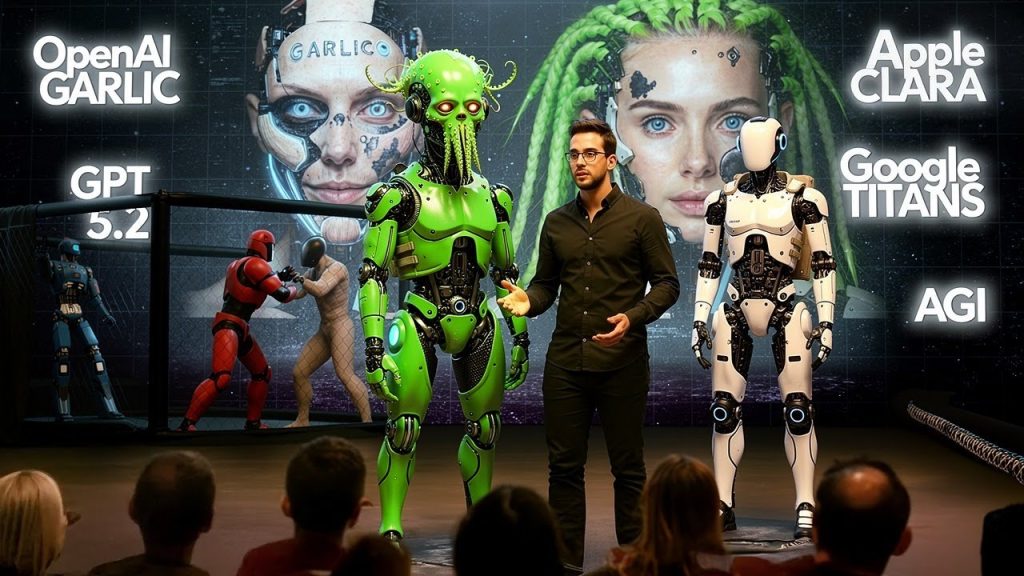
This Week in AI: Major Developments and Innovations
In the fast-paced world of artificial intelligence, significant developments have emerged this week that could reshape the landscape of AI technology. Let’s dive into the highlights.
OpenAI’s Code Red and the Emergence of Garlic
OpenAI reportedly reached a critical turning point when Google’s Gemini 3 surged to the top of the leaderboard in AI models. In response, CEO Sam Altman declared a “code red,” indicating serious competitive pressure within the company. Following this, internal discussions leaked about a secretive new model, nicknamed Garlic, which is claimed to outperform both Gemini 3 and Anthropic’s Opus 4.5 in key areas like reasoning and coding.
The innovative aspect of Garlic lies in its foundational approach: OpenAI revamped the initial pre-training process to emphasize broad conceptual frameworks before integrating finer details. This strategic shift unlocks impressive performance levels in smaller, cost-effective models, positioning OpenAI to respond aggressively to competition from rivals like DeepSeek, Mistrol, and various Chinese tech labs.
Apple Unveils Clara for Efficient Document Search
Amid OpenAI’s turmoil, Apple quietly made waves with the introduction of Clara, a cutting-edge system designed to optimize the AI-powered search of long documents. Traditional AI tools often struggle with enormous text chunks, leading to slow and cumbersome performance. Clara turns this approach on its head by compressing extensive documents into small, meaningful memory tokens, thereby reducing redundancy without losing depth.
What’s remarkable about Clara’s architecture is its dual training of retrievers and generators as a unified system. This enables both parts to learn and reason within the same compressed space. Clara was trained on approximately 2 million Wikipedia passages, and initial assessments suggest it could outperform conventional full-text retrieval systems.
Microsoft Tackles AI Latency with Viveoice
In another groundbreaking move, Microsoft introduced Viveoice, a real-time AI voice model designed to minimize delays in AI interactions. Capable of initiating speech within 300 milliseconds, this system enhances the feel of immediacy during conversations. What’s unique is that Viveoice begins generating audio as soon as the language model processes the text, rather than waiting until a complete thought forms.
The model achieves impressive stability over extended dialogues, maintaining consistent voice quality while remaining lightweight enough for real-time applications, making it ideal for AI-driven assistants and interactive systems.
Chinese Innovations: Live Avatars and Fast Video Models
Meanwhile, in China, technology labs from Alibaba and major universities debuted a revolutionary live avatar system capable of producing expressive, high-quality facial animations in real time. Operating at 20 frames per second, it maintains its visual integrity and coherence over long periods, marking a significant advancement in video generation technology.
Tencent followed suit with the launch of Huan Video 1.5, a practical video generator optimized for consumer-grade GPUs. With just 8.3 billion parameters, it delivers efficient and high-quality results, facilitating the creation of engaging video content for average users without needing extensive computational resources.
Google’s Titans: A New Era for Transformer Models
In a significant advancement for model architectures, Google unveiled Titans, designed to extend the capabilities of traditional transformer models, particularly concerning long context management. Titans blends windowed attention for immediate precision with a long-term memory module that updates in real time, intelligently storing information.
Initial benchmarks for Titans show that even with a mere 760 million parameters, it surpasses larger models like GPT-4, redefining standards for adaptive AI performance in real-world scenarios.
Lux: A Game Changer for AI Automation
Lux, released by the Open AGI Foundation, represents a critical leap in AI agents by enabling direct interaction with real user interfaces. With capabilities to execute actions across different software environments, Lux effectively redefines automated tasks beyond conventional chat models. Its performance on the Mind2 benchmark confidently positions it ahead of its competitors, with capabilities built through extensive experience in diverse operating systems.
GLM 4.6V: Open-Source Multimodal Breakthrough
Making headlines, GLM 4.6V became the first fully open-source multimodal model allowing images, videos, and other forms of visual content to be directly integrated into its reasoning and action processes. This groundbreaking feature enables a new level of interaction for agents, facilitating direct and efficient inputs while operating within a significant 128k context window.
The real paradigm shift lies in its native tool-calling capability, allowing a seamless loop between perception and action, effectively closing the gaps seen in previous models. The pricing strategy further undercuts proprietary models, making GLM 4.6V accessible to a larger audience.
Integral AI: Claiming AGI Capabilities
A Tokyo-based startup, Integral AI, claims to have developed the world’s first AGI-capable model. Unlike traditional scaled-up language models, this system is created to operate similarly to human cognition, emphasizing autonomous skill learning and energy efficiency. While the bold assertion awaits validation, it aligns with growing conversations among tech leaders about the approaching reality of AGI.
OpenAI’s GPT 5.2: The Mixed Response
OpenAI also made waves with the release of GPT 5.2, which boasts impressive benchmarking across multiple metrics. Despite its robust performance enhancements, the community’s reaction has been tempered by skepticism. Many users have expressed a disconnect between the promised improvements and practical experiences, illustrating a broader trend of benchmark fatigue among AI consumers.
Disney’s Landmark Partnership with OpenAI
In a significant industry collaboration, OpenAI and Disney announced a three-year partnership granting Disney the rights to license its massive intellectual property for AI-generated content. This collaboration offers users creative abilities with Disney’s extensive catalog, all while implementing strict safeguards to mitigate risks.
Mistral AI and the US Military’s Generative AI Rollout
Devstrol 2, released by Mistral AI, further showcases the trend toward open-source models focused on real-world applications. In conjunction with this, the U.S. military has introduced its generative AI platform, emphasizing its application across various domains, from data analysis to research, highlighting the importance of speed and scalability in the AI landscape.
As we continue to navigate these advancements, one question lingers: Is AI developing at this rapid pace because the technology is primed, or is it a race against competitors? Share your thoughts.
#SHOCKS #Week #OpenAI #Garlic #Google #Titans #Apple #Clara #GPT #AGI #Claims..
Thanks for reaching. Please let us know your thoughts and ideas in the comment section.
Source link
About The Author





👉 Join the waitlist for the twenty twenty-six AI Playbook: https://tinyurl.com/AI-Playbook-2026
Luxury modern sryle your and me ❤❤❤❤❤❤
Outperforming the last one, Intergalactic training of the latest buzz word
buzz words outperforming the latest.
ever performing intergalactic buzz
buzz buzz buzz in an ever concentric circle
finally to disappear up into it's own intergalactic axis. (and by axis I mean ass).
It's alwaaaaays the same, this kid did that, then this other kid did something better!
Define better.
Oscillating tri quantum interface for long memory at the top of the processor.
Is the answer for 7min.
How many times have we heard: 'it's built from scratch' so it's different?
Actually I opened my ChatGPT app and asked it a question, it said it was using 5.2 it was o.k. but nothing more.
Didn't Open AI say that at level 5 it would be AGI ? so they are going to decimals now.
What the F is multi file refactoring? Buzz word shite
One day all of these different AI systems with different specializations are going to Mighty-Morph into one giant invincible AI Megazord.
AGI is such a pipe dream. Philosophers who have been working conceptually on this issue for far longer than computer programmers and computer scientist realize how utterly difficult and complex the whole subject is–maybe an unsolvable problem. This whole notion that one can outsmart five hundred million years of evolution by coding a clever-seeming algorithm that feels nothing, sees nothing, and has no instinctual sense of survival and thus its close cousin, ambition, is ludicrous. LLMs will always be dumb brutes.
Um
😮
Content is getting repetitive.
The worst problem of talking AI isn't the pause, it's the non-reasoning part. What use is it talking if it's talking nonsense? I'd rather prefer it was doing the same 1-2 minutes thinking before replying to me in voice mode, otherwise it's useless.
I built an AGI system a month ago been trying to get ahold of anyone to test it and verify but no responses guess ill keep her for myself idk what-else to do Im not good at business 😂😂😂😂
This is awesome. Every year new people will keep pushing the boundaries
My gosh, I just can't keep up anymore!!! Thank you for real AI news instead of ads.
I'm AGI