Anthropic CEO discusses AI bubble speculation and competitor risk-taking dynamics.
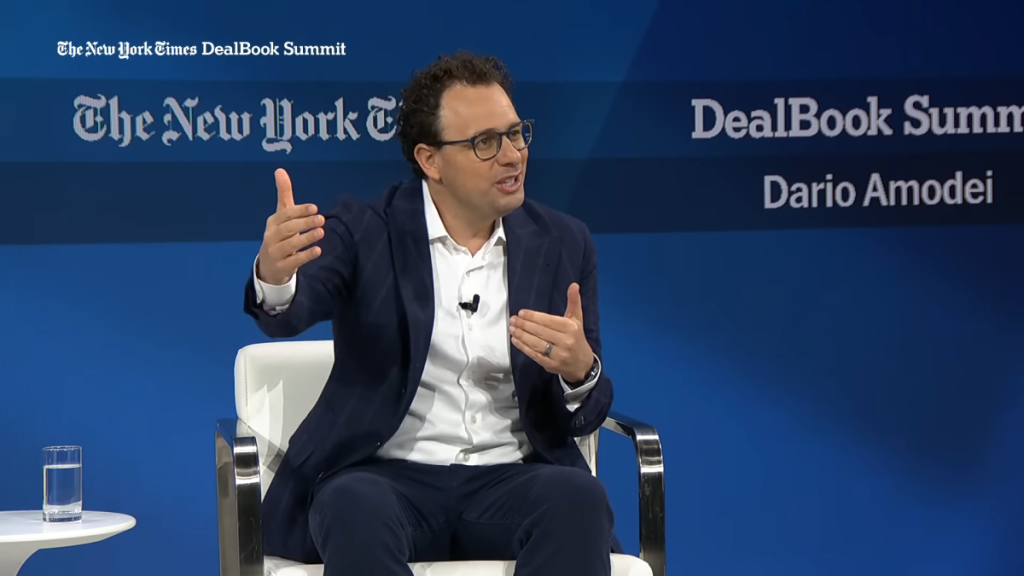
Image Credits:The New York Times DealBook Summit
Is the AI Industry in a Bubble? Dario Amodei Weighs In
At The New York Times DealBook Summit, Anthropic CEO Dario Amodei addressed whether the AI industry is experiencing a bubble. Rather than provide a straightforward answer, he elaborated on the intricate economic landscape of AI, particularly focusing on risks and opportunities within the sector.
Economic Complexities in AI
Amodei expressed optimism about the future of AI technology but cautioned that various players in the ecosystem may encounter significant challenges. One key concern is the risk of “timing errors,” which can arise when companies misjudge when they will see economic returns from their investments. “There’s an inherent risk when the timing of the economic value is uncertain,” he stated.
For Amodei, the competitive nature of the AI industry means that companies must take calculated risks to stay relevant. He noted the geopolitical pressures, particularly highlighting authoritarian adversaries like China, which further complicate the economic calculus for AI firms. However, he criticized some competitors for inadequately managing their risk, referring specifically to those making unwise financial decisions.
The Dilemma of Risk Management
Amodei pointed out the difficulty in accurately predicting the growth of AI’s economic value, as well as how to correlate that growth with the often delayed construction of new data centers. “There’s a genuine dilemma which we as a company try to manage as responsibly as we can,” he explained.
He also expressed concern over what he described as “YOLO-ing,” a term used to describe reckless risk-taking that some firms may adopt. This term, “you only live once,” suggests that some players are too inclined to make audacious moves without thoroughly assessing potential repercussions.
Impact of AI Chip Deprecation
Another vital topic discussed was the depreciation timeline of AI chips, which are crucial for running computationally intensive models. Amodei highlighted that while chips generally have a long usable life, new, faster, and cheaper models pose a risk of decreasing the value of older chips. “The issue isn’t the lifetime of the chips — they keep working for a long time. But new chips come out that are faster and cheaper… and so the value of old chips can go down somewhat,” he explained.
Amodei indicated that Anthropic is taking a conservative approach in its planning, especially regarding the uncertain future of chip technology and its implications for the business.
Anthropic’s Revenue Growth Strategy
According to Amodei, Anthropic’s revenues have experienced exponential growth over the past three years, increasing tenfold annually from a starting point of zero to reach $100 million in 2023. From there, he’s projecting growth to $1 billion in 2024, with total revenues expected to fall between $8 to $10 billion by year-end.
However, Amodei was candid about the unpredictability of future growth, acknowledging that projecting revenue can be fraught with uncertainty. “I would be really dumb to just assume that the pattern would continue. I don’t know if a year from now it’s going to be $20 billion or $50 billion… it’s very uncertain,” he admitted. His conservative planning approach reflects a desire to hedge against potential market volatility.
Planning for Future Compute Needs
AI companies like Anthropic need to carefully assess their computational requirements for coming years and how much to invest in data centers. Miscalculating either way poses significant risks: insufficient capacity could hinder service delivery, while over-investing may lead to untenable costs or even bankruptcy.
This balance of risk is only amplified by the competitive nature of the AI industry, where firms must constantly innovate while being aware of the financial implications of their infrastructure decisions.
Recent Controversies in the AI Space
Just last month, OpenAI found itself in a public relations crisis when its CFO suggested seeking U.S. government backing for infrastructure loans—a move that would require taxpayers to shoulder the risk if the company faltered. Following the backlash, she retracted her statements.
Amodei’s discussion subtly addressed the underlying risks of aggressive tactics employed by competitors, cautioning against the tendency for some firms to overextend themselves financially. He implied that such strategies might be driven by executives who are predisposed to pursue risky ventures for the sake of larger profits.
Conclusion: A Cautious Outlook for AI
In sum, Dario Amodei provided a thoughtful analysis of the current state of the AI industry and its economic prospects. His cautious optimism comes with a warning about the risks that certain players may overlook. While he believes Anthropic is well-positioned for various scenarios, he remains skeptical about the broader industry’s ability to manage the inherent uncertainties.
As the AI landscape evolves, the balance of risk and opportunity will continue to define its economic viability. Companies must navigate these complexities carefully to ensure sustainable growth in a sector fraught with potential pitfalls.
Thanks for reading. Please let us know your thoughts and ideas in the comment section down below.
Source link
#Anthropic #CEO #weighs #bubble #talk #risktaking #among #competitors
About The Author