
Google Leverages AI and Historical Reports to Anticipate Flash Floods
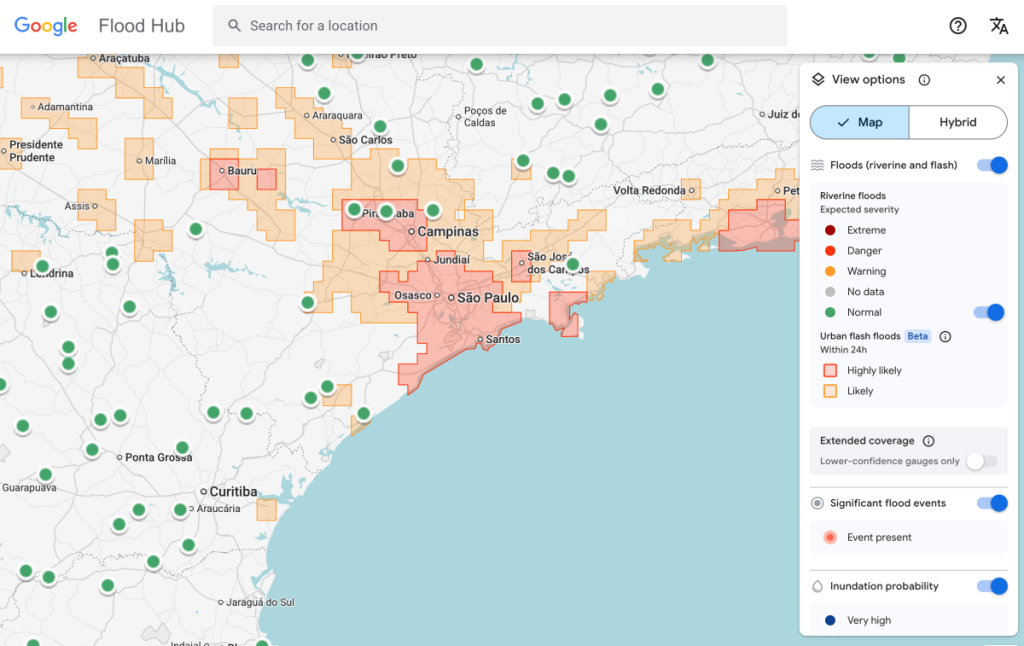
Image Credits:Google Flood Hub
Understanding Flash Floods: A Severe Weather Challenge
Flash floods are one of the most lethal weather phenomena globally, claiming over 5,000 lives annually. Their unpredictability makes them particularly dangerous, as they occur suddenly and can devastate localities without warning. Despite advancements in weather forecasting, predicting flash floods has remained a complex challenge due to their short-lived and localized nature.
The Data Gap in Flash Flood Prediction
While an immense amount of meteorological data is available, flash floods are difficult to measure in the same way that temperature and river flows are tracked over time. This data scarcity poses a significant hurdle for deep learning models, which have shown remarkable capabilities in forecasting various weather events. The limitations in data mean these models often fail to accurately predict flash floods.
Google’s Innovative Solution: Utilizing News Data
To tackle this conundrum, researchers at Google have taken an unconventional yet groundbreaking approach. By employing Gemini, Google’s large language model, they analyzed 5 million news articles from around the globe. This analysis isolated 2.6 million flood reports and transformed them into a geo-tagged time series known as “Groundsource.” This innovative use of language models is a first for Google and its potential impact on forecast accuracy is significant.
Creating the Groundsource Dataset
Groundsource serves as a real-world baseline that allows the researchers to train a model based on Long Short-Term Memory (LSTM) neural networks. By integrating this dataset with global weather forecasts, the model can estimate the likelihood of flash floods in specific regions. This advancement represents a significant leap in the application of artificial intelligence in environmental science.
Spread of Flash Flood Information via Google’s Flood Hub
The flash flood forecasting model is now operational in urban areas across 150 countries, made accessible on Google’s Flood Hub platform. Additionally, the model shares vital data with emergency response agencies worldwide. For instance, António José Beleza, an emergency response official with the Southern African Development Community, has reported that this model has accelerated their response times to imminent floods.
Recognizing Limitations
Despite its innovative features, the model does have limitations. Currently, it operates at a relatively low resolution, assessing risk across 20-square-kilometer areas, and lacks the precision of the US National Weather Service’s flood alert system. This is largely because Google’s model does not incorporate local radar data, which is essential for real-time tracking of precipitation.
More Than Just a Forecasting Tool
The project aims to assist regions that lack the financial resources to invest in costly weather-sensing infrastructure or don’t have extensive meteorological data histories. This makes the model particularly valuable in developing nations or underserved regions where traditional forecasting methods may fall short.
Groundsource: A New Frontier in Weather Data
Juliet Rothenberg, a program manager with Google’s Resilience team, highlighted the significance of aggregating millions of flood reports through the Groundsource project. She stated that the dataset effectively “rebalance[s] the map,” allowing extrapolation to areas where relevant information is sparse. This means that even in regions with limited data, predictions can still be made with a greater degree of accuracy.
Future Implications and Applications
Beyond flash floods, Rothenberg envisions that LLMs can venture into other transient but critical weather phenomena, such as heat waves and mudslides. The application of language models for quantitative purposes could redefine how meteorological data is collected and utilized, potentially paving the way for advanced forecasting techniques in various fields.
Industry Perspectives on Data Scarcity
Marshall Moutenot, CEO of Upstream Tech, which employs deep learning models for river flow forecasting, echoed the sentiment regarding data scarcity in geophysical research. He noted the dual challenge: while there is an ocean of Earth data available, useful and validated datasets for real-world application are limited. He praised Google’s innovative approach as a valuable contribution to bridging this gap.
Conclusion: The Future of Flash Flood Predictions
The intersection of AI and meteorology represents a crucial frontier in managing and predicting flash floods. By leveraging large datasets from unconventional sources, Google’s Groundsource project demonstrates a pioneering approach that could save lives by improving prediction accuracy. As researchers continue to refine these models and broaden their applications, we may see a significant reduction in the impact of flash floods and other weather-related disasters in the near future.
The efforts undertaken by Google and its research team showcase the transformative power of artificial intelligence in addressing urgent global challenges—most notably, in areas where traditional forecasting methods are insufficient. As we move forward, collaborations between tech companies, researchers, and emergency response teams will be vital in crafting a more resilient future against the forces of nature.
Thanks for reading. Please let us know your thoughts and ideas in the comment section down below.
Source link
#Google #news #reports #predict #flash #floods
About The Author