

web analytics

Learn AI With Kesse | Best Place For AI News

We make artificial intelligence easy and fun to read. Get Updated AI News.

Trump’s AI Executive Order Promises ‘Unified Regulation’; Startups Face Legal Uncertainty
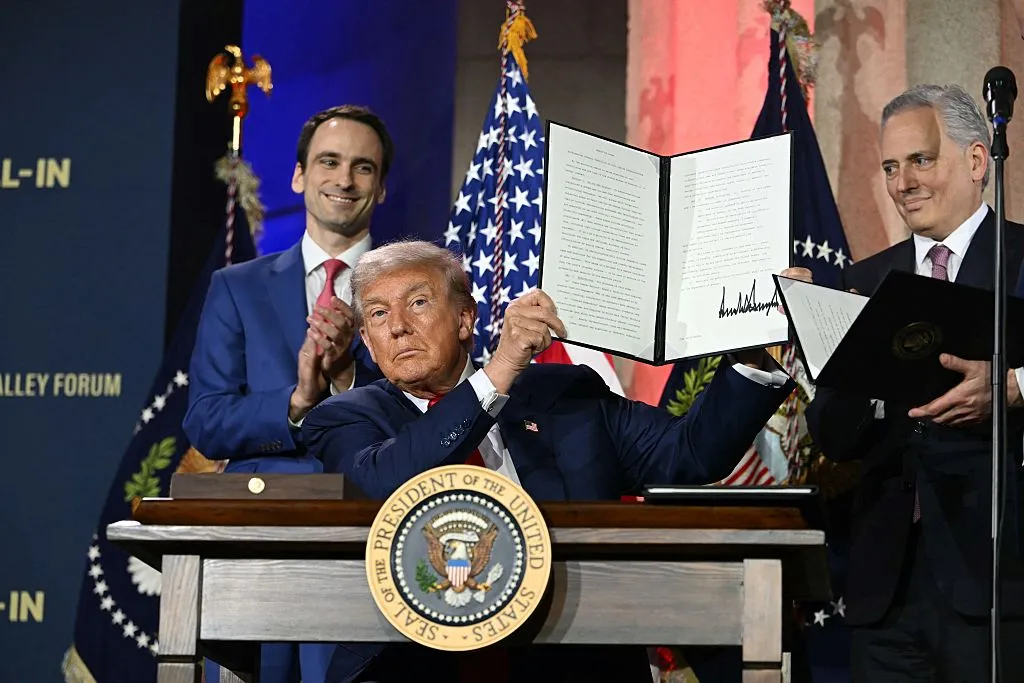
US President Donald Trump displays an executive order on artificial intelligence he signed at the "Winning the AI Race" AI Summit at the Andrew W.

Image Credits:ANDREW CABALLERO-REYNOLDS/AFP / Getty Images

Trump Signs Executive Order to Challenge State AI Laws

On Thursday evening, President Donald Trump issued an executive order aimed at federal agencies to contest state-level AI regulations. The rationale presented is that startups require support against what Trump describes as a “patchwork” of rules. Legal experts and those within the startup community express concerns that the order may actually create prolonged uncertainty, inciting legal battles that would leave emerging companies to grapple with inconsistent state regulations as they await a consensus in Congress for a unified national framework.

Key Provisions of the Executive Order

The executive order, entitled “Ensuring a National Policy Framework for Artificial Intelligence,” mandates that the Department of Justice establish a task force within 30 days to challenge certain state laws. The focus is on the assertion that AI constitutes interstate commerce requiring federal regulation. Additionally, it allocates 90 days for the Commerce Department to identify “onerous” state AI laws, a move that could subsequently affect states’ eligibility for federal funds, including broadband grants.

Furthermore, the order directs the Federal Trade Commission (FTC) and the Federal Communications Commission (FCC) to consider federal standards that may supersede state requirements. The administration is also instructed to collaborate with Congress on creating a uniform AI law.

The Context of State-Level AI Regulation

This order arrives amid a broader initiative to streamline AI regulations across states, particularly following the stagnation of federal efforts in Congress to halt state legislation. Lawmakers from both political parties have made a case that without a federal guideline, barring states from acting could leave consumers vulnerable and companies largely unregulated.

Michael Kleinman, the head of U.S. Policy at the Future of Life Institute, accused the administration of prioritizing Silicon Valley interests. He described the executive order as a “gift for Silicon Valley oligarchs” who exploit their influence in Washington to evade accountability.

Lack of Immediate Clarity for Startups

Despite its ambitious intentions, the order has drawn fire even from proponents of a national policy framework, as it does not establish one right away. State laws remain enforceable unless courts intervene or states voluntarily choose to pause enforcement. This creates a potential protracted transition period for startups attempting to navigate an evolving regulatory landscape.

Sean Fitzpatrick, CEO of LexisNexis North America, U.K., and Ireland, outlined the likelihood that states would vigorously defend their consumer protection authority in court, with cases potentially escalating to the Supreme Court. While some proponents argue that the executive order could centralize the regulation discussion in Washington, critics forewarn that the ensuing legal conflicts may soon hinder startups as they try to comply with contradictory state and federal demands.

Hart Brown, principal author of Oklahoma Governor Kevin Stitt’s Task Force on AI and Emerging Technology recommendations, noted that startups typically lack robust regulatory governance until they scale up. This absence of preparedness could make it difficult for smaller enterprises to meet complex compliance demands.

Startup Concerns over Regulatory Uncertainty

The challenges posed by the fluctuating regulatory environment extend to many notable figures in the startup landscape. Arul Nigam, co-founder of Circuit Breaker Labs, a company specializing in red-teaming for conversational AI and mental health chatbots, expressed apprehensions. Companies like his face uncertainties regarding whether AI products require self-regulation, and whether standards should be adhered to. He acknowledged that the fragmented state laws are detrimental, especially for smaller startups.

Conversely, Nigam also expressed hope for Congress to act more swiftly in enacting a more comprehensive federal framework.

Andrew Gamino-Cheong, co-founder and CTO of the AI governance firm Trustible, articulated the concern that the executive order might inadvertently stifle AI innovation. He suggested that larger tech companies could more easily mitigate the ambiguity through legal resources, leaving smaller startups, which are less financially equipped, at a disadvantage.

Increasing Complexity of Sales and Trust Issues

Legal ambiguity poses additional hurdles for startups trying to attract risk-sensitive clients in sectors such as law, finance, and healthcare. Gamino-Cheong claimed that the perception of AI being unregulated could further diminish trust—a critical factor for broad adoption. As businesses attempt to navigate these complexities, increased sales cycles and mounting insurance costs could become the norm.

Gary Kibel, a partner at Davis + Gilbert, pointed out that while many in the business community would welcome a unified national AI regulation, an executive order may not be the most effective means to override state-enacted laws. He noted that the current regulatory uncertainty could lead to two extremes: stringent regulations or a complete lack of action, creating a chaotic “Wild West” scenario where big tech can afford to take risks.

Call for Legislative Action

In response to this complex situation, Morgan Reed, president of The App Association, urged Congress to quickly establish a “comprehensive, targeted, and risk-based national AI framework.” Reed emphasized that the existence of disjointed state laws, combined with potential prolonged court deliberations over the executive order’s constitutionality, is detrimental to the tech ecosystem.

Conclusion

As the executive order sets the stage for challenging existing state laws on AI, the unfolding story underscores deep uncertainties and complexities for startups. Those advocating for a national framework must grapple not only with shifting regulations but also with the overarching challenge of promoting innovation while ensuring accountability. The path forward remains unclear, but it is evident that swift and decisive action is necessary to create an environment where AI innovation can thrive within a coherent regulatory landscape.

Thanks for reading. Please let us know your thoughts and ideas in the comment section down below.

Source link
#Trumps #executive #order #promises #rulebook #startups #legal #limbo

About The Author

Leave a Reply

Your email address will not be published. Required fields are marked *

We use cookies to personalize content and ads and to primarily analyze our geo traffic sources. We also may share information about your use of our site with our social media, advertising, and analytics partners to improve your user experience. We respect your privacy and will never abuse your information. [ Privacy Policy ] View more
Cookies settings
Accept
Decline
Privacy & Cookie Policy
Privacy & Cookies policy
Cookie name Active

The content on this page governs our Privacy Policy. It describes how your personal information is collected, used, and shared when you visit or make a purchase from learnaiwithkesse.com (the "Site").

Kesseswebsites and Advertising owns Learn AI With Kesse and the website learnaiwithkesse.wiki. For the purpose of this Terms and Agreements [ we, us, I, our ] represents the owner of Learning AI With Kesse which is Kesseswebsites and Advertising. [ You, your, student and buyer ] represents you as the user and visitor of this site. Terms of Conditions, Terms of Service, Terms and Agreement and Terms of use shall be considered the same here. This website or site refers to https://learnaiwithkesse.com. You agree that the content of this Terms and Agreement may include Privacy Policy and Refund Policy. Products refer to physical or digital products. This includes eBooks, PDFs, and text or video courses. If there is anything on this page you do not understand you agree to reach out to us via email [ emmanuel@learnaiwithkesse.com ] for explanation before using any part of this site.

1. Personal Information We Collect

When you visit this Site, we automatically collect certain information about your device, including information about your web browser, IP address, time zone, and some of the cookies that are installed on your device. The primary purpose of this activity is to provide you a better user experience the next time you visit our again and also the data collection is for analytics study. Additionally, as you browse the Site, we collect information about the individual web pages or products that you view, what websites or search terms referred you to the Site, and information about how you interact with the Site. We refer to this automatically-collected information as "Device Information."

We collect Device Information using the following technologies:

"Cookies" are data files that are placed on your device or computer and often include an anonymous unique identifier. For more information about cookies, and how to disable cookies, visit http://www.allaboutcookies.org. To comply with European Union's GDPR (General Data Protection Regulation), we do display a disclaimer a consent text at the bottom of this website. This disclaimer alerts you the visitor or user of this website about why we use cookies, and we also give you the option to accept or decline. If you accept for us to use cookies on your site, the agreement between you and us will expire after 180 has passed.

"Log files" track actions occurring on the Site, and collect data including your IP address, browser type, Internet service provider, referring/exit pages, and date/time stamps.

"Web beacons," "tags," and "pixels" are electronic files used to record information about how you browse the Site.

Additionally, when you make a purchase or attempt to make a purchase through the Site, we collect certain information from you, including your name, billing address, shipping address, payment information (including credit card numbers), email address, and phone number. We refer to this information as "Order Information."

When we talk about "Personal Information" in this Privacy Policy, we are talking both about Device Information and Order Information.

Payment Information

Please note that we use 3rd party payment processing companies like https://stripe.com and https://paypal.com to process your payment information. PayPal and Stripe protects your data according to their terms and agreement and may store your data to help make your subsequent transactions on this website easier. We never and [ DO NOT ] store your card information or payment login information on our website or server. By making payment on our site, you agree to abide by the Terms and Agreement of the 3rd Party payment processing companies we use. You can visit their websites to read their Terms of Use and learn more about them.

2. How Do We Use Your Personal Information?

We use the Order Information that we collect generally to fulfill any orders placed through the Site (including processing your payment information, arranging for shipping, and providing you with invoices and/or order confirmations). Additionally, we use this [a] Order Information to:

[b] Communicate with you;

[c] Screen our orders for potential risk or fraud; and

When in line with the preferences you have shared with us, provide you with information or advertising relating to our products or services. We use the Device Information that we collect to help us screen for potential risk and fraud (in particular, your IP address), and more generally to improve and optimize our Site (for example, by generating analytics about how our customers browse and interact with the Site, and to assess the success of our marketing and advertising campaigns).

3. Sharing Your Personal Information

We share your Personal Information with third parties to help us use your Personal Information, as described above. For example, we use System.io to power our online store--you can read more about how Systeme.io uses your Personal Information here: https://systeme.io/privacy-policy/ . We may also use Google Analytics to help us understand how our customers use the Site--you can read more about how Google uses your Personal Information here: https://www.google.com/intl/en/policies/privacy/. You can also opt-out of Google Analytics here: https://tools.google.com/dlpage/gaoptout.

Finally, we may also share your Personal Information to comply with applicable laws and regulations, to respond to a subpoena, search warrant or other lawful request for information we receive, or to otherwise protect our rights.

4. Behavioral Advertising

As described above, we use your Personal Information to provide you with targeted advertisements or marketing communications we believe may be of interest to you. For more information about how targeted advertising works, you can visit the Network Advertising Initiative’s (“NAI”) educational page at http://www.networkadvertising.org/understanding-online-advertising/how-does-it-work.

You can opt-out of targeted advertising by:

COMMON LINKS INCLUDE:

FACEBOOK - https://www.facebook.com/settings/?tab=ads

GOOGLE - https://www.google.com/settings/ads/anonymous

BING - https://advertise.bingads.microsoft.com/en-us/resources/policies/personalized-ads]

Additionally, you can opt-out of some of these services by visiting the Digital Advertising Alliance’s opt-out portal at: http://optout.aboutads.info/.

5. Data Retention

Besides your card payment and payment login information, when you place an order through the Site, we will maintain your Order Information for our records unless and until you ask us to delete this information. Example of such information include your first name, last name, email and phone number.

6. Changes

We may update this privacy policy from time to time in order to reflect, for example, changes to our practices or for other operational, legal or regulatory reasons.

7. Contact Us

For more information about our privacy practices, if you have questions, or if you would like to make a complaint, please contact us by e-mail at emmanuel@learnaiwithkesse.com or by mail using the details provided below:

8. Your acceptance of these terms

By using this Site, you signify your acceptance of this policy. If you do not agree to this policy, please do not use our Site. Your continued use of the Site following the posting of changes to this policy will be deemed your acceptance of those changes.

Last Update | 18th August 2024

Save settings
Cookies settings