

web analytics

Learn AI With Kesse | Best Place For AI News

We make artificial intelligence easy and fun to read. Get Updated AI News.

Google Leverages AI and Historical Reports to Anticipate Flash Floods
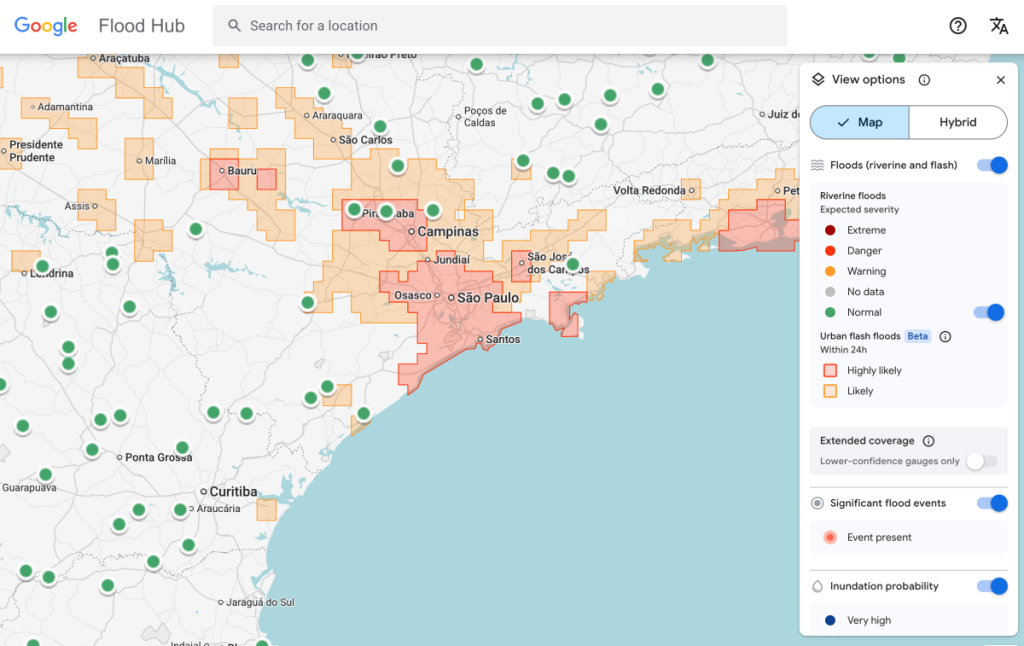
Google is using old news reports and AI to predict flash floods

Image Credits:Google Flood Hub

Understanding Flash Floods: A Severe Weather Challenge

Flash floods are one of the most lethal weather phenomena globally, claiming over 5,000 lives annually. Their unpredictability makes them particularly dangerous, as they occur suddenly and can devastate localities without warning. Despite advancements in weather forecasting, predicting flash floods has remained a complex challenge due to their short-lived and localized nature.

The Data Gap in Flash Flood Prediction

While an immense amount of meteorological data is available, flash floods are difficult to measure in the same way that temperature and river flows are tracked over time. This data scarcity poses a significant hurdle for deep learning models, which have shown remarkable capabilities in forecasting various weather events. The limitations in data mean these models often fail to accurately predict flash floods.

Google’s Innovative Solution: Utilizing News Data

To tackle this conundrum, researchers at Google have taken an unconventional yet groundbreaking approach. By employing Gemini, Google’s large language model, they analyzed 5 million news articles from around the globe. This analysis isolated 2.6 million flood reports and transformed them into a geo-tagged time series known as “Groundsource.” This innovative use of language models is a first for Google and its potential impact on forecast accuracy is significant.

Creating the Groundsource Dataset

Groundsource serves as a real-world baseline that allows the researchers to train a model based on Long Short-Term Memory (LSTM) neural networks. By integrating this dataset with global weather forecasts, the model can estimate the likelihood of flash floods in specific regions. This advancement represents a significant leap in the application of artificial intelligence in environmental science.

Spread of Flash Flood Information via Google’s Flood Hub

The flash flood forecasting model is now operational in urban areas across 150 countries, made accessible on Google’s Flood Hub platform. Additionally, the model shares vital data with emergency response agencies worldwide. For instance, António José Beleza, an emergency response official with the Southern African Development Community, has reported that this model has accelerated their response times to imminent floods.

Recognizing Limitations

Despite its innovative features, the model does have limitations. Currently, it operates at a relatively low resolution, assessing risk across 20-square-kilometer areas, and lacks the precision of the US National Weather Service’s flood alert system. This is largely because Google’s model does not incorporate local radar data, which is essential for real-time tracking of precipitation.

More Than Just a Forecasting Tool

The project aims to assist regions that lack the financial resources to invest in costly weather-sensing infrastructure or don’t have extensive meteorological data histories. This makes the model particularly valuable in developing nations or underserved regions where traditional forecasting methods may fall short.

Groundsource: A New Frontier in Weather Data

Juliet Rothenberg, a program manager with Google’s Resilience team, highlighted the significance of aggregating millions of flood reports through the Groundsource project. She stated that the dataset effectively “rebalance[s] the map,” allowing extrapolation to areas where relevant information is sparse. This means that even in regions with limited data, predictions can still be made with a greater degree of accuracy.

Future Implications and Applications

Beyond flash floods, Rothenberg envisions that LLMs can venture into other transient but critical weather phenomena, such as heat waves and mudslides. The application of language models for quantitative purposes could redefine how meteorological data is collected and utilized, potentially paving the way for advanced forecasting techniques in various fields.

Industry Perspectives on Data Scarcity

Marshall Moutenot, CEO of Upstream Tech, which employs deep learning models for river flow forecasting, echoed the sentiment regarding data scarcity in geophysical research. He noted the dual challenge: while there is an ocean of Earth data available, useful and validated datasets for real-world application are limited. He praised Google’s innovative approach as a valuable contribution to bridging this gap.

Conclusion: The Future of Flash Flood Predictions

The intersection of AI and meteorology represents a crucial frontier in managing and predicting flash floods. By leveraging large datasets from unconventional sources, Google’s Groundsource project demonstrates a pioneering approach that could save lives by improving prediction accuracy. As researchers continue to refine these models and broaden their applications, we may see a significant reduction in the impact of flash floods and other weather-related disasters in the near future.

The efforts undertaken by Google and its research team showcase the transformative power of artificial intelligence in addressing urgent global challenges—most notably, in areas where traditional forecasting methods are insufficient. As we move forward, collaborations between tech companies, researchers, and emergency response teams will be vital in crafting a more resilient future against the forces of nature.

Thanks for reading. Please let us know your thoughts and ideas in the comment section down below.

Source link
#Google #news #reports #predict #flash #floods

About The Author

Leave a Reply

Your email address will not be published. Required fields are marked *

We use cookies to personalize content and ads and to primarily analyze our geo traffic sources. We also may share information about your use of our site with our social media, advertising, and analytics partners to improve your user experience. We respect your privacy and will never abuse your information. [ Privacy Policy ] View more
Cookies settings
Accept
Decline
Privacy & Cookie Policy
Privacy & Cookies policy
Cookie name Active

The content on this page governs our Privacy Policy. It describes how your personal information is collected, used, and shared when you visit or make a purchase from learnaiwithkesse.com (the "Site").

Kesseswebsites and Advertising owns Learn AI With Kesse and the website learnaiwithkesse.wiki. For the purpose of this Terms and Agreements [ we, us, I, our ] represents the owner of Learning AI With Kesse which is Kesseswebsites and Advertising. [ You, your, student and buyer ] represents you as the user and visitor of this site. Terms of Conditions, Terms of Service, Terms and Agreement and Terms of use shall be considered the same here. This website or site refers to https://learnaiwithkesse.com. You agree that the content of this Terms and Agreement may include Privacy Policy and Refund Policy. Products refer to physical or digital products. This includes eBooks, PDFs, and text or video courses. If there is anything on this page you do not understand you agree to reach out to us via email [ emmanuel@learnaiwithkesse.com ] for explanation before using any part of this site.

1. Personal Information We Collect

When you visit this Site, we automatically collect certain information about your device, including information about your web browser, IP address, time zone, and some of the cookies that are installed on your device. The primary purpose of this activity is to provide you a better user experience the next time you visit our again and also the data collection is for analytics study. Additionally, as you browse the Site, we collect information about the individual web pages or products that you view, what websites or search terms referred you to the Site, and information about how you interact with the Site. We refer to this automatically-collected information as "Device Information."

We collect Device Information using the following technologies:

"Cookies" are data files that are placed on your device or computer and often include an anonymous unique identifier. For more information about cookies, and how to disable cookies, visit http://www.allaboutcookies.org. To comply with European Union's GDPR (General Data Protection Regulation), we do display a disclaimer a consent text at the bottom of this website. This disclaimer alerts you the visitor or user of this website about why we use cookies, and we also give you the option to accept or decline. If you accept for us to use cookies on your site, the agreement between you and us will expire after 180 has passed.

"Log files" track actions occurring on the Site, and collect data including your IP address, browser type, Internet service provider, referring/exit pages, and date/time stamps.

"Web beacons," "tags," and "pixels" are electronic files used to record information about how you browse the Site.

Additionally, when you make a purchase or attempt to make a purchase through the Site, we collect certain information from you, including your name, billing address, shipping address, payment information (including credit card numbers), email address, and phone number. We refer to this information as "Order Information."

When we talk about "Personal Information" in this Privacy Policy, we are talking both about Device Information and Order Information.

Payment Information

Please note that we use 3rd party payment processing companies like https://stripe.com and https://paypal.com to process your payment information. PayPal and Stripe protects your data according to their terms and agreement and may store your data to help make your subsequent transactions on this website easier. We never and [ DO NOT ] store your card information or payment login information on our website or server. By making payment on our site, you agree to abide by the Terms and Agreement of the 3rd Party payment processing companies we use. You can visit their websites to read their Terms of Use and learn more about them.

2. How Do We Use Your Personal Information?

We use the Order Information that we collect generally to fulfill any orders placed through the Site (including processing your payment information, arranging for shipping, and providing you with invoices and/or order confirmations). Additionally, we use this [a] Order Information to:

[b] Communicate with you;

[c] Screen our orders for potential risk or fraud; and

When in line with the preferences you have shared with us, provide you with information or advertising relating to our products or services. We use the Device Information that we collect to help us screen for potential risk and fraud (in particular, your IP address), and more generally to improve and optimize our Site (for example, by generating analytics about how our customers browse and interact with the Site, and to assess the success of our marketing and advertising campaigns).

3. Sharing Your Personal Information

We share your Personal Information with third parties to help us use your Personal Information, as described above. For example, we use System.io to power our online store--you can read more about how Systeme.io uses your Personal Information here: https://systeme.io/privacy-policy/ . We may also use Google Analytics to help us understand how our customers use the Site--you can read more about how Google uses your Personal Information here: https://www.google.com/intl/en/policies/privacy/. You can also opt-out of Google Analytics here: https://tools.google.com/dlpage/gaoptout.

Finally, we may also share your Personal Information to comply with applicable laws and regulations, to respond to a subpoena, search warrant or other lawful request for information we receive, or to otherwise protect our rights.

4. Behavioral Advertising

As described above, we use your Personal Information to provide you with targeted advertisements or marketing communications we believe may be of interest to you. For more information about how targeted advertising works, you can visit the Network Advertising Initiative’s (“NAI”) educational page at http://www.networkadvertising.org/understanding-online-advertising/how-does-it-work.

You can opt-out of targeted advertising by:

COMMON LINKS INCLUDE:

FACEBOOK - https://www.facebook.com/settings/?tab=ads

GOOGLE - https://www.google.com/settings/ads/anonymous

BING - https://advertise.bingads.microsoft.com/en-us/resources/policies/personalized-ads]

Additionally, you can opt-out of some of these services by visiting the Digital Advertising Alliance’s opt-out portal at: http://optout.aboutads.info/.

5. Data Retention

Besides your card payment and payment login information, when you place an order through the Site, we will maintain your Order Information for our records unless and until you ask us to delete this information. Example of such information include your first name, last name, email and phone number.

6. Changes

We may update this privacy policy from time to time in order to reflect, for example, changes to our practices or for other operational, legal or regulatory reasons.

7. Contact Us

For more information about our privacy practices, if you have questions, or if you would like to make a complaint, please contact us by e-mail at emmanuel@learnaiwithkesse.com or by mail using the details provided below:

8. Your acceptance of these terms

By using this Site, you signify your acceptance of this policy. If you do not agree to this policy, please do not use our Site. Your continued use of the Site following the posting of changes to this policy will be deemed your acceptance of those changes.

Last Update | 18th August 2024

Save settings
Cookies settings