

DuckDuckGo Sees 30% Increase as Users Push Back Against Google’s AI Search
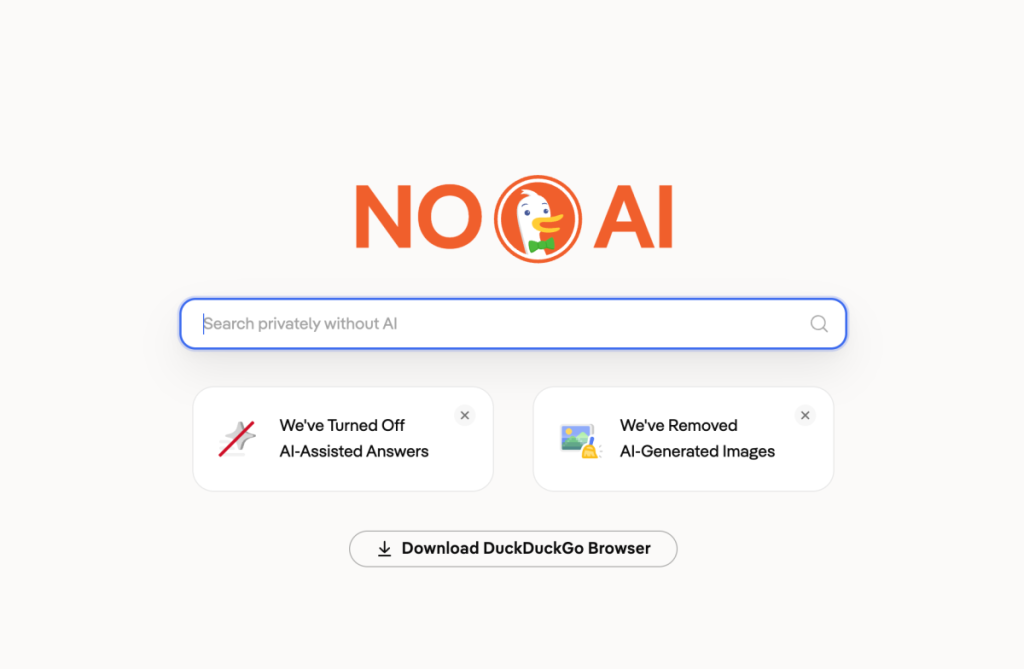
Image Credits:DuckDuckGo
Growing Discontent with Google’s Search Overhaul
In light of Google’s recent announcement about a significant update to its Search function, many users are reconsidering their search engine options. Recently, I overheard a woman expressing her intention to switch to DuckDuckGo because it allows users to “opt out of using AI.” Her sentiment, “Google just isn’t Google anymore,” reflects a growing wave of discontent among users.
The Shift to AI-Powered Search
During the annual I/O developer conference, Google unveiled plans to replace its traditional blue link system with an AI agent capable of articulating responses, performing tasks, and managing background monitoring features. This overhaul has drawn considerable backlash.
Critics argue that this shift could threaten the open web, with many expressing concerns that AI-generated responses may not always be accurate. There’s also anxiety regarding user autonomy; not everyone wishes to rely on AI for their searches. For instance, a simple search for the term “disregard” has become more complex with AI interventions.
The Rise of DuckDuckGo Amidst Changes
In response to Google’s transformation, users are increasingly gravitating towards alternatives like DuckDuckGo, a privacy-focused search engine that has historically struggled to gain traction, holding just about 2% of the U.S. search market.
During the 2023 antitrust trial against Google, DuckDuckGo CEO Gabriel Weinberg highlighted the detrimental impact of Google’s exclusive search contracts, which impede its ability to position itself as a default option across other browsers.
Weinberg stated, “Google is force-feeding AI with no way to opt out. As a result, their results are getting worse, not better. We want to be the place that puts users in charge and lets them decide how much AI they want.”
Notable Increases in DuckDuckGo Usage
Recent statistics suggest that DuckDuckGo is beginning to reap the benefits of this backlash against AI-centric search features. From May 20 to May 25, U.S. app installations surged by an average of 18.1% week-over-week, peaking at 30.5% on May 25. On iOS devices, the growth rate was even more pronounced, reaching an average of 33% and peaking at an astonishing 69.9%.
Moreover, visits to DuckDuckGo’s AI-free search page, noai.duckduckgo.com, saw a significant increase, averaging 22.7% growth week-over-week, peaking at 27.7% on May 24. This page automatically disables AI features like AI-assisted answers and AI-generated images, making it an attractive option for users wishing to avoid AI tools altogether. DuckDuckGo reported sustained user growth even over Memorial Day weekend, a period typically marked by declining traffic.
DuckDuckGo’s AI Offering: A Different Approach
Although DuckDuckGo champions itself as an AI-free search engine, it provides a unique AI product called Duck.ai. This feature is free and does not require users to create an account, allowing access to various AI models, including Anthropic’s Claude 4.5 Haiku, Meta’s Llama 4 Scout, Mistral’s Small 3 24B, and OpenAI’s GPT-5 mini. Importantly, DuckDuckGo prioritizes user privacy: it strips away the user’s IP address before forwarding requests, deletes conversation histories within 30 days, and ensures that interactions are not used for training AI models.
Weinberg emphasized, “Not only do we respect user choice, but also user privacy. Everything you do in DuckDuckGo is private; we don’t collect search histories or chats, and nothing is used for AI training.”
Popular Features Catering to User Preferences
DuckDuckGo also has features like Search Assist and an AI Image Filter. The Search Assist function is reminiscent of Google’s AI overviews, while the AI Image Filter helps to exclude AI-generated images from the search results.
Kamyl Bazbaz, DuckDuckGo’s Chief Communications and Policy Officer, noted that both features remain highly popular despite their contrasting philosophies. He stated, “People just want a choice,” underscoring the growing demand for more agency in choosing how to engage with technology.
Conclusion
As Google integrates more AI into its services, users are expressing their discontent and seeking alternatives that prioritize privacy and user control. DuckDuckGo is gaining traction, positioning itself as a viable option for those who want to maintain oversight of their online searches. With growing installation numbers and user engagement, DuckDuckGo demonstrates that the desire for choice in search tools is resonating with a significant segment of consumers.
TechCrunch has reached out to Google for comment on this ongoing situation. Meanwhile, as users continue to adapt to changes in digital search, we may witness a fundamental shift in how information is accessed online.
When you engage with links in our articles, know that we may earn a small commission, which does not affect our editorial independence.
Thanks for reading. Please let us know your thoughts and ideas in the comment section down below.
Source link
#DuckDuckGo #installs #users #reject #forcefed #Googles #Search
About The Author