

Google Launches Dreambeans in India to Deliver AI-Generated Personal Stories to Everyone
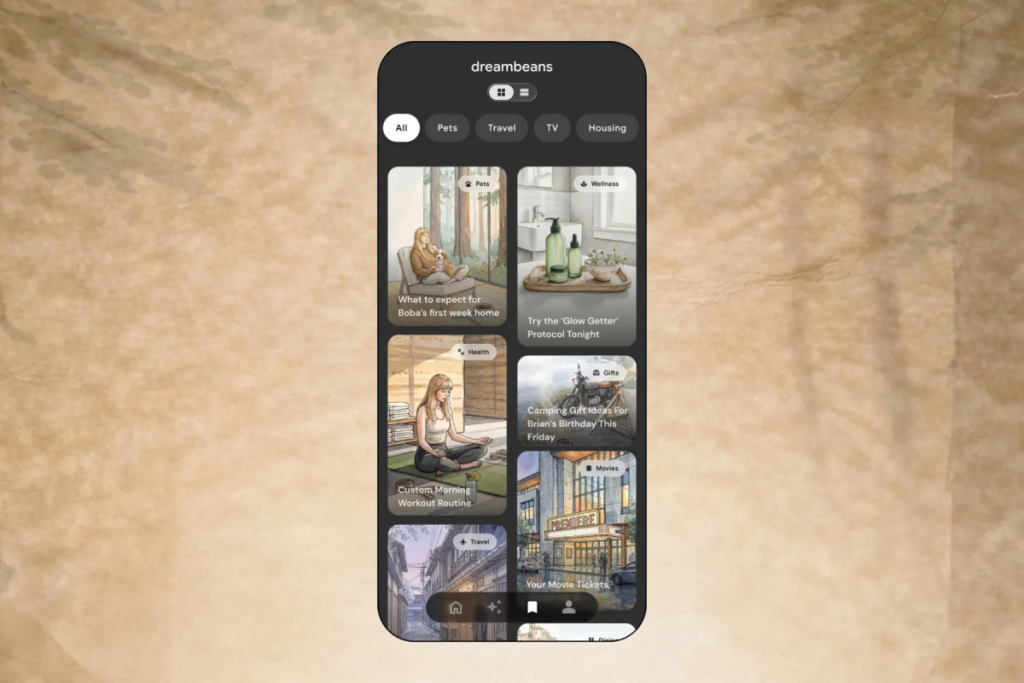
Image Credits:Google
Google Launches Dreambeans AI App in India
Google has debuted its experimental AI application, Dreambeans, in India, marking the company’s first expansion beyond the United States. This strategic move aims to leverage India’s status as the world’s second-largest internet market, bringing personalized visual storytelling based on users’ digital interactions to a wider audience.
Features of Dreambeans
Launched on Monday for both Android and iOS platforms, Dreambeans offers support for 13 local languages, including Hindi, Punjabi, Tamil, Telugu, and Bengali, in addition to English. This release comes less than two months after the app was made accessible to all eligible users aged 18 and older in the U.S.
Originally introduced in June, Dreambeans utilizes data from various Google services like Calendar, Gmail, Photos, Search, and YouTube to automatically create personalized illustrated narratives about users’ interests and daily experiences without requiring any prompts. While initially featuring static illustrations, the app has recently integrated the Veo video-generation model to animate certain stories.
Rationale Behind Choosing India
Google selected India as the first international market for Dreambeans due to the substantial interest expressed by Indian users keen on accessing the app, along with the extensive use of its services throughout the country. According to Google product manager Gozde Oznur, India demonstrates a high overlap of user bases across apps like Gemini, Gmail, and Google Photos, making it a viable choice for such a launch.
Performance Metrics in the U.S.
Since its launch in the U.S., Dreambeans has achieved approximately 55,000 downloads, based on estimates from Sensor Tower, a market intelligence firm. Notably, about 63% of these downloads occurred in September, coinciding with the app’s availability to all eligible users. However, the app faced a significant decline in downloads, plummeting 84% month-over-month to around 5,500 in October.
In its initial month of broader U.S. availability, Dreambeans recorded an estimated 29,000 downloads, which compares favorably to but still lags behind other AI applications like Meta’s Muse, ChatGPT, Grok Bot, and Claude. Unlike these more general-purpose AI tools, Dreambeans specifically focuses on creating personalized stories.
Language Limits and Cultural Considerations
Although Dreambeans caters to several widely spoken Indian languages, users are limited to selecting just one language for their generated stories at a time. The app is capable of utilizing information from multiple Google services across different languages, but it cannot currently produce stories that combine languages—an aspect that might limit its appeal in a multilingual country like India, where many users frequently switch between Hindi and English, a mix commonly referred to as Hinglish.
Privacy Concerns
The app’s dependence on users’ Google account information raises significant privacy and data access concerns. Utilizing Google’s Personal Intelligence technology, Dreambeans pulls data from connected services to create personalized stories. Given that these services may contain sensitive personal information, some users might hesitate to share this data with an AI app purely for customized content.
Users have control over which Google services are connected to Dreambeans and can disconnect them at any time. Additionally, users can delete their Dreambeans data directly within the app, with a reassurance from Oznur that information erased from connected services will also be removed from Dreambeans’ personalization framework.
Customization and User Control
Dreambeans does offer a level of customization, allowing users to specify topics they would like the app to avoid, including business-related content. The app is designed solely for personal Gmail account holders, ensuring that generated stories can only be seen by the account owner.
However, Dreambeans’ proactive storytelling capabilities also bear the risk of surfacing sensitive memories, which some users may find distressing. Oznur acknowledged this aspect, noting that Dreambeans has the potential to include narratives involving individuals who have passed away. Users can opt out of seeing such stories, with features similar to those in Google Photos that give users control over which memories are displayed.
Future Developments
Oznur also indicated that Google is exploring ways to make Dreambeans even more actionable, aiming to evolve beyond merely providing personalized stories and recommendations. This innovation may enable users to take tangible actions based on the app’s suggestions, a crucial aspect that could enhance user engagement.
Conclusion
Dreambeans is an ambitious endeavor for Google as it seeks to penetrate the Indian market with an AI-driven storytelling application. While the app’s initial launch is promising, its future success will hinge on addressing key limitations, particularly in language versatility and privacy considerations. As the app develops, it may offer more features and controls that align with user expectations and cultural nuances, allowing it to truly resonate with the diverse landscape of Indian internet users.
When you purchase through links in our articles, we may earn a small commission. This doesn’t affect our editorial independence.
Thanks for reading. Please let us know your thoughts and ideas in the comment section down below.
Source link
#Google #takes #Dreambeans #India #bid #bring #AIgenerated #personal #stories #masses
About The Author