
Google’s new AI weather model ensures you never forget your umbrella again.
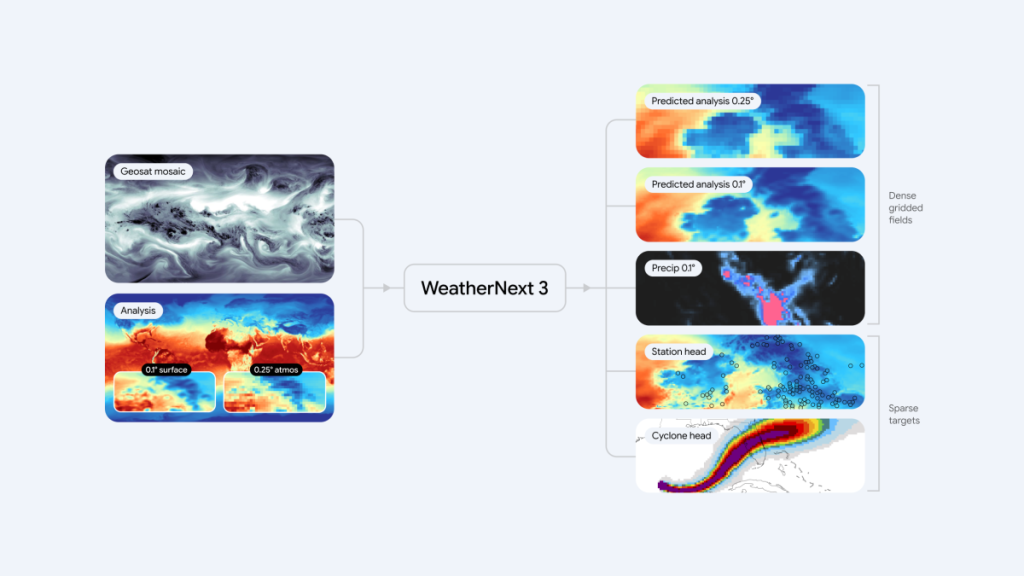
Image Credits:Google / Google
Introduction to WeatherNext 3
Google DeepMind and Google Research have unveiled WeatherNext 3, an innovative artificial intelligence model designed to enhance weather forecasting. This advanced model provides clearer visibility into our changing atmosphere and improves the accuracy of weather predictions.
A New Era in Meteorology
WeatherNext 3 marks a significant step forward in meteorology, leveraging cutting-edge deep learning techniques. Google plans to integrate this model into various products, including search results, Google Maps, and Gemini, while also offering it on Google Cloud for researchers and users.
Key Features and Accuracy
According to Samier Merchant, a senior staff engineer at Google, this model will utilize core variables that will power numerous Google products for the first time. WeatherNext 3 has emerged as the most accurate AI weather forecasting model when tested on Operational WeatherBench, a benchmarking tool created by startup Brightband. This model assesses essential metrics such as temperature, wind speed, and humidity.
It outperforms competitors from major players like Google, Microsoft, Nvidia, and the European Center for Medium-Range Weather Forecasting (ECMWF), as well as traditional forecasts from the US National Weather Service and ECMWF itself.
Transitioning from Traditional Methods to AI
Historically, weather forecasts have relied on government-operated supercomputers that process complex mathematical equations to forecast weather conditions. These systems have become quite reliable but are often expensive and slow. After the ECMWF released extensive weather data in 2018, deep learning researchers began developing models capable of making swift and accurate predictions comparable to traditional methods.
Ferran Alet, a research scientist at DeepMind, articulates the challenge of weather predictability: “Weather is chaotic, and small differences can have massive impacts. Machine learning addresses this issue by learning patterns from vast amounts of data, despite noise and incomplete information.”
Overcoming AI Forecasting Limitations
AI forecasting models have historically faced limitations, such as predicting over large areas (15 to 25 square kilometers), struggles with rain predictions, and a dependency on formatted data from government sources. WeatherNext 3 aims to address these challenges head-on.
- Improved Resolution: Researchers indicate that this model predicts with remarkable resolution, down to 5 kilometers for key variables.
- Enhanced Rain Forecasting: WeatherNext 3 has seen a 60% improvement in rain evaluations compared to its predecessor, WeatherNext 2.
- Frequent Forecasts: It can produce hourly forecasts, moving beyond the conventional six-hour prediction format.
Model Enhancements and Design Choices
The improvements in WeatherNext 3 are largely attributed to specific design choices made during its development. First, it has 2.4 times more parameters than the previous model, allowing for more refined outputs. Additionally, the researchers have fine-tuned the model to visualize cyclone paths effectively.
Targeting Specific Weather Stations
The creators of WeatherNext 3 have trained the AI to focus its forecasts on specific weather stations. This is crucial for providing more granular predictions and evaluating results against actual ground data.
Daniel Rothenberg, an atmospheric scientist at Brightband, says, “The aim of many AI applications is to perform tasks as end-to-end as possible. Adding capabilities for model predictions tailored to specific weather stations enhances the accuracy of the forecasts.”
Ingesting Real-Time Data
One of the groundbreaking features of WeatherNext 3 is its ability to receive hourly weather satellite data in real-time. This approach allows the model to be fed directly with raw empirical observations rather than processed analyses from supercomputers, enhancing forecast accuracy. However, working with unformatted data presents technical challenges.
While Google claims WeatherNext 3 is the first AI model to incorporate raw observations for high-resolution global forecasts, the startup WindBorne argues that its model, WeatherMesh 6, has been doing so since late 2025. Google counters this claim by emphasizing that its forecasts are of higher resolution globally. Nevertheless, both models still rely on national weather datasets to improve forecast capability.
The Future of AI in Meteorology
While large language models (LLMs) have received considerable attention, the transformer revolution in meteorology is equally transformative. European and US weather agencies have begun integrating AI models into their forecast products, significantly improving speed and reducing costs. This innovation promises economic benefits to regions struggling for access to accurate forecasts due to the high cost of advanced sensors and computing resources.
Distinguished figures, such as Bill Gates, have underscored the importance of AI-driven weather forecasting. Enhanced forecasts can lead to improved agricultural outcomes in developing nations, thereby positively impacting food security and rural economies.
Applications Beyond Weather Forecasting
The increased accuracy and granularity of forecasts provided by WeatherNext 3 will have broader implications as well. Alet mentions that precise forecasts of wind, rain, and cloud cover are essential for making renewable energy projects more reliable.
He notes, “Google’s ultimate goal is to deliver useful information to users. A significant portion of what people seek aligns with weather conditions.”
Conclusion
WeatherNext 3 represents a significant leap forward in the field of meteorology, blending advanced AI technologies with real-time data to deliver accurate and timely weather forecasts. As AI continues to revolutionize this field, we can expect a future with more accessible, reliable weather information, which can bring about beneficial changes for communities worldwide.
By focusing on improving the accuracy, frequency, and resolution of weather forecasts, WeatherNext 3 positions itself not only as a tool for users but also as a catalyst for advancements in agriculture, renewable energy, and beyond. With ongoing innovations in AI, the future of weather forecasting looks increasingly bright.
Thanks for reading. Please let us know your thoughts and ideas in the comment section down below.
Source link
#Googles #latest #weather #model #excuse #forget #umbrella
About The Author