The content on this page governs our Privacy Policy. It describes how your personal information is collected, used, and shared when you visit or make a purchase from learnaiwithkesse.com (the "Site").
Kesseswebsites and Advertising owns Learn AI With Kesse and the website learnaiwithkesse.wiki. For the purpose of this Terms and Agreements [ we, us, I, our ] represents the owner of Learning AI With Kesse which is Kesseswebsites and Advertising. [ You, your, student and buyer ] represents you as the user and visitor of this site. Terms of Conditions, Terms of Service, Terms and Agreement and Terms of use shall be considered the same here. This website or site refers to https://learnaiwithkesse.com. You agree that the content of this Terms and Agreement may include Privacy Policy and Refund Policy. Products refer to physical or digital products. This includes eBooks, PDFs, and text or video courses. If there is anything on this page you do not understand you agree to reach out to us via email [ emmanuel@learnaiwithkesse.com ] for explanation before using any part of this site.
1. Personal Information We Collect
When you visit this Site, we automatically collect certain information about your device, including information about your web browser, IP address, time zone, and some of the cookies that are installed on your device. The primary purpose of this activity is to provide you a better user experience the next time you visit our again and also the data collection is for analytics study. Additionally, as you browse the Site, we collect information about the individual web pages or products that you view, what websites or search terms referred you to the Site, and information about how you interact with the Site. We refer to this automatically-collected information as "Device Information."
We collect Device Information using the following technologies:
"Cookies" are data files that are placed on your device or computer and often include an anonymous unique identifier. For more information about cookies, and how to disable cookies, visit http://www.allaboutcookies.org. To comply with European Union's GDPR (General Data Protection Regulation), we do display a disclaimer a consent text at the bottom of this website. This disclaimer alerts you the visitor or user of this website about why we use cookies, and we also give you the option to accept or decline. If you accept for us to use cookies on your site, the agreement between you and us will expire after 180 has passed.
"Log files" track actions occurring on the Site, and collect data including your IP address, browser type, Internet service provider, referring/exit pages, and date/time stamps.
"Web beacons," "tags," and "pixels" are electronic files used to record information about how you browse the Site.
Additionally, when you make a purchase or attempt to make a purchase through the Site, we collect certain information from you, including your name, billing address, shipping address, payment information (including credit card numbers), email address, and phone number. We refer to this information as "Order Information."
When we talk about "Personal Information" in this Privacy Policy, we are talking both about Device Information and Order Information.
Payment Information
Please note that we use 3rd party payment processing companies like https://stripe.com and https://paypal.com to process your payment information. PayPal and Stripe protects your data according to their terms and agreement and may store your data to help make your subsequent transactions on this website easier. We never and [ DO NOT ] store your card information or payment login information on our website or server. By making payment on our site, you agree to abide by the Terms and Agreement of the 3rd Party payment processing companies we use. You can visit their websites to read their Terms of Use and learn more about them.
2. How Do We Use Your Personal Information?
We use the Order Information that we collect generally to fulfill any orders placed through the Site (including processing your payment information, arranging for shipping, and providing you with invoices and/or order confirmations). Additionally, we use this [a] Order Information to:
[b] Communicate with you;
[c] Screen our orders for potential risk or fraud; and
When in line with the preferences you have shared with us, provide you with information or advertising relating to our products or services. We use the Device Information that we collect to help us screen for potential risk and fraud (in particular, your IP address), and more generally to improve and optimize our Site (for example, by generating analytics about how our customers browse and interact with the Site, and to assess the success of our marketing and advertising campaigns).
3. Sharing Your Personal Information
We share your Personal Information with third parties to help us use your Personal Information, as described above. For example, we use System.io to power our online store--you can read more about how Systeme.io uses your Personal Information here: https://systeme.io/privacy-policy/ . We may also use Google Analytics to help us understand how our customers use the Site--you can read more about how Google uses your Personal Information here: https://www.google.com/intl/en/policies/privacy/. You can also opt-out of Google Analytics here: https://tools.google.com/dlpage/gaoptout.
Finally, we may also share your Personal Information to comply with applicable laws and regulations, to respond to a subpoena, search warrant or other lawful request for information we receive, or to otherwise protect our rights.
4. Behavioral Advertising
As described above, we use your Personal Information to provide you with targeted advertisements or marketing communications we believe may be of interest to you. For more information about how targeted advertising works, you can visit the Network Advertising Initiative’s (“NAI”) educational page at http://www.networkadvertising.org/understanding-online-advertising/how-does-it-work.
You can opt-out of targeted advertising by:
COMMON LINKS INCLUDE:
FACEBOOK - https://www.facebook.com/settings/?tab=ads
GOOGLE - https://www.google.com/settings/ads/anonymous
BING - https://advertise.bingads.microsoft.com/en-us/resources/policies/personalized-ads]
Additionally, you can opt-out of some of these services by visiting the Digital Advertising Alliance’s opt-out portal at: http://optout.aboutads.info/.
5. Data Retention
Besides your card payment and payment login information, when you place an order through the Site, we will maintain your Order Information for our records unless and until you ask us to delete this information. Example of such information include your first name, last name, email and phone number.
6. Changes
We may update this privacy policy from time to time in order to reflect, for example, changes to our practices or for other operational, legal or regulatory reasons.
7. Contact Us
For more information about our privacy practices, if you have questions, or if you would like to make a complaint, please contact us by e-mail at emmanuel@learnaiwithkesse.com or by mail using the details provided below:
8. Your acceptance of these terms
By using this Site, you signify your acceptance of this policy. If you do not agree to this policy, please do not use our Site. Your continued use of the Site following the posting of changes to this policy will be deemed your acceptance of those changes.
Last Update | 18th August 2024




Get the free 7-agent guide here: https://go.aiskool.io/7agents
Thanku for Information🤍
WOW!
No, this is the biggest release for 9 days.
hype (cough cough) hype. but hey, at least it doesn't cost tokens. but yeah – bigger hype than fable (waste of tokens there).
The comparison should have included Mythos to be objective
it's not as big a release as i'm going to be in a couple weeks ʘ ͜つʘ
american greed turned inward
Any Open models meeting or beating frontier is good, but I want the focus to be on modular 120B and smaller models, natively trained in FP4, and incorporating Subquadratic scaling and sparse attention architectures. There is no practical use case for members of the public to have even a 1T parameter model. Models for the public should be made to fit comfortably in 24gb VRAM or 128gb Unified Memory.
This is is why one analyst I spoke to was livid about her company investing heavily into some Western AI firms: she stated that the Chinese are playing this smart, letting Western firms spend the mega dollars and then copying/training/learning from them, whilst making continual improvements and researching areas where Western companies seem to be missing . The gap is narrowing, and the Chinese have achieved this for a fraction of the outlay the West has made.
Simply, the Chinese are offering 80-90%+ of the capability of leading Western models for 10-20% of the cost of the best Western models – and that is within a few months of the best Western models being released.
2.8 T dense would be an achievement. MoE is less exciting
Fun fact, KIMI means f*** you im Chinese
Textbook socialism … the world should not be ruled by ultra-capitalist techno-feudalists from the US.
The Chinese have spent the past 40 years steaing IP and data from white people. Now you are about to invite a Chinese LLM into your home and your busness just because its and its cheap. They are good because they set up 25,000 fake accounts to steal from Anthropic. You are going to wake up to an empty bank account.
BRO BASICALLY GOES FROM AI KILLING US ALL TOO NORMAL INFORMATION
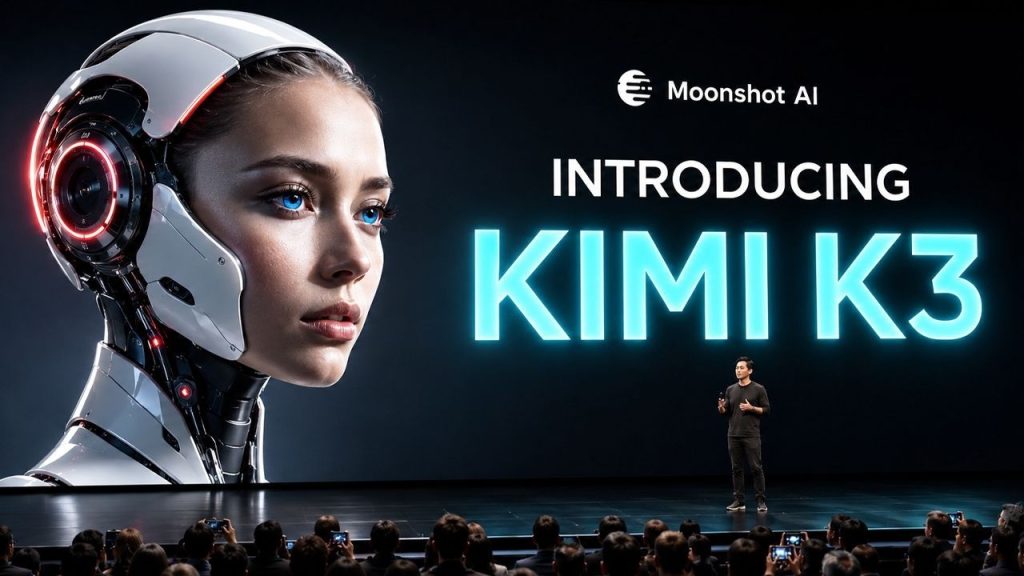
The transcript told us that Kimi K3 is technologically impressive. It did not tell us whether K3 is economically disruptive enough to undermine the American AI-capital-spending model.
That is the central missing answer.
What the transcript left out
1. The real cost of operating K3
“Open-weight” does not mean inexpensive to operate.
Moonshot recommends at least 64 AI accelerators, but the transcript never provides:
• The exact accelerator type
• Power consumption
• Memory and networking requirements
• Tokens generated per second under full load
• Utilization needed to justify ownership
• Annual depreciation and maintenance
• Total cost per completed task
A company comparing K3 with OpenAI or Anthropic should compare:
—not merely API token prices but total cost.
For many businesses, paying an American provider may remain cheaper than constructing and operating a 64-accelerator cluster.
2. Whether 2.8 trillion parameters actually matters
The transcript repeatedly emphasizes 2.8 trillion parameters, but K3 is a mixture-of-experts model with only 16 of 896 experts active for a token.
Consequently, total parameters are partly a marketing measurement. What matters operationally is:
• Active parameters per token
• Memory bandwidth
• Communication among accelerators
• Inference latency
• Throughput
• Quality per dollar and per watt
The transcript never gives K3’s active-parameter count or a normalized comparison against American models. Without that, “largest model” does not necessarily mean “most capable” or “most efficient.”
3. Independent validation of its extraordinary demonstrations
Claims that K3:
• Designed a chip
• Built a compiler
• Improved GPU code for 15 hours
• Reproduced an astrophysics study
• Completed weeks of work in hours
come primarily from Moonshot demonstrations.
The transcript acknowledges this briefly but never asks:
• How often did K3 fail?
• How many attempts were required?
• How much human correction was hidden?
• Were the tasks selected because K3 performed particularly well on them?
• Did specialists verify that the outputs were actually correct?
• Could another model reproduce the same results under identical conditions?
A successful demonstration establishes possibility, not reliability.
4. Benchmark width and benchmark contamination
K3’s benchmark results are real enough to take seriously: Artificial Analysis currently scores it at 57. But that score aggregates a selected group of evaluations; it does not demonstrate superiority across all commercial work. K3 also generated approximately 130 million evaluation tokens, about twice the comparison average—suggesting that some of its performance may require considerably more inference work. Artificial Analysis
The transcript also omitted:
• Confidence intervals
• Variability between repeated runs
• Benchmark contamination risk
• Performance at different reasoning budgets
• Performance when prompts are imperfect
• Cost per correct answer
• Latency per completed task
Those are crucial because an agent that scores slightly higher but consumes twice the tokens may not be economically superior.
5. The difference between open-weight and open-source
The transcript loosely uses “open model” and “open-source” interchangeably.
Releasing weights does not automatically disclose:
• Training data
• Data-cleaning methodology
• Training code
• Reinforcement-learning process
• Safety training
• Full model architecture and reproducible training recipe
Until the weights and license are released and inspected—reportedly July 27—we will not know how freely K3 can actually be modified, redistributed, commercialized, or audited.
6. Data security is not automatically solved
The transcript claims companies can host K3 themselves and therefore keep data private. That is possible, but incomplete.
It omitted:
• Whether the weights contain exploitable backdoors
• Supply-chain and dependency risks
• Telemetry in associated software
• Security audits
• Model provenance
• Enterprise indemnification
• Compliance with American government restrictions
• Whether regulated industries will permit its use
A bank, defense contractor or government agency cannot adopt a Chinese model merely because it is cheaper and downloadable.
7. China’s censorship and political-control layer
Xi’s offer of “open access” was presented largely at face value. The transcript did not examine whether Chinese models:
• Refuse politically sensitive subjects
• Carry embedded government-aligned behavior
• Can be uncensored after downloading
• Must comply with Chinese content rules
• Export Chinese technical standards and governance assumptions
China may be offering openness at the weight level while retaining influence through infrastructure, training, standards, financing and deployment relationships.
That does not invalidate the strategy. It clarifies what China is exporting: an entire ecosystem, not simply a model.
8. Actual adoption
The transcript jumps directly from benchmark performance to disruption of American providers.
Missing were:
• Paying enterprise customers
• Developer usage
• Download numbers
• Renewal and retention rates
• Production deployments
• Revenue
• Support capability
• Integration with existing enterprise software
• Evidence that customers are replacing OpenAI, Anthropic or Google
Competitive capability is not the same as commercial substitution.
9. Moonshot’s underlying economics
The quoted API price may not be profitable.
We were not told:
• Training cost
• Inference gross margin
• Accelerator subsidies
• Government support
• Whether launch prices are promotional
• How much Alibaba or Tencent infrastructure is being supplied below market cost
• Whether Moonshot can serve substantial demand at those prices
China may be using model pricing strategically—accepting poor near-term returns to capture standards and market share. That would make K3 geopolitically disruptive but not necessarily proof of superior standalone economics.
10. What it means for semiconductor demand
This is particularly important for your SOX and AI-infrastructure work.
The transcript assumes cheaper, more capable Chinese models threaten American AI providers. It does not establish whether K3 reduces total accelerator demand.
There are two opposing effects:
K3 may pressure model-provider margins while simultaneously increasing global demand for accelerators, memory, networking, electricity and data centers. Therefore, it is not automatically bearish for NVDA, AVGO, MU, AMD, KLAC or AMAT.
The bearish semiconductor case would require evidence that:
1. Existing compute becomes sufficient;
2. Frontier training requirements stop increasing;
3. Hyperscalers reduce capital expenditures;
4. Chinese substitution occurs without equivalent new infrastructure construction.
The transcript provided none of that evidence.
11. It did not separate stock-price impact from fundamental impact
The Chinese competitor declines demonstrate investor reaction, not proven deterioration in revenue or earnings.
Likewise, the comparison with DeepSeek’s earlier market shock confuses:
• A one-day valuation adjustment
• Pricing pressure on model companies
• Reduced infrastructure demand
• Long-term American technological decline
Those are different propositions.
12. The political organization’s substance
The 29-country AI organization sounds important, but the transcript never identified:
• The 29 countries
• Binding commitments
• Funding
• Governance or voting structure
• Infrastructure contributions
• Technical standards adopted
• Whether members are meaningful AI producers or primarily recipients
Xi’s initiative is strategically important, and Reuters confirms China is explicitly positioning itself as an alternative center of AI governance. But membership announcements alone do not yet establish an operational Chinese-led AI bloc. Reuters
My conclusion
The transcript is directionally important but analytically incomplete.
K3 provides strong evidence that China is closing the frontier-model capability gap and has developed a deliberate strategy:
Use open weights, low prices, training and infrastructure assistance to distribute Chinese AI throughout the developing world.
What it does not establish is that China has surpassed the United States economically, commercially, or in the underlying compute stack.
For your market work, the immediate warning is more precise:
K3 threatens the pricing power and scarcity premium attached to proprietary frontier models. It does not yet demonstrate that the physical AI buildout—chips, memory, networks, data centers and electricity—is slowing.
That missing distinction is the most important thing the transcript did not tell us.
…and with that I'm unsubscribed to BAIT.
You really think America is showing you all the best that they have? 😂
China literally stole everything they have from USA