

Nvidia’s AI Edge Expands Beyond GPUs to New Frontiers
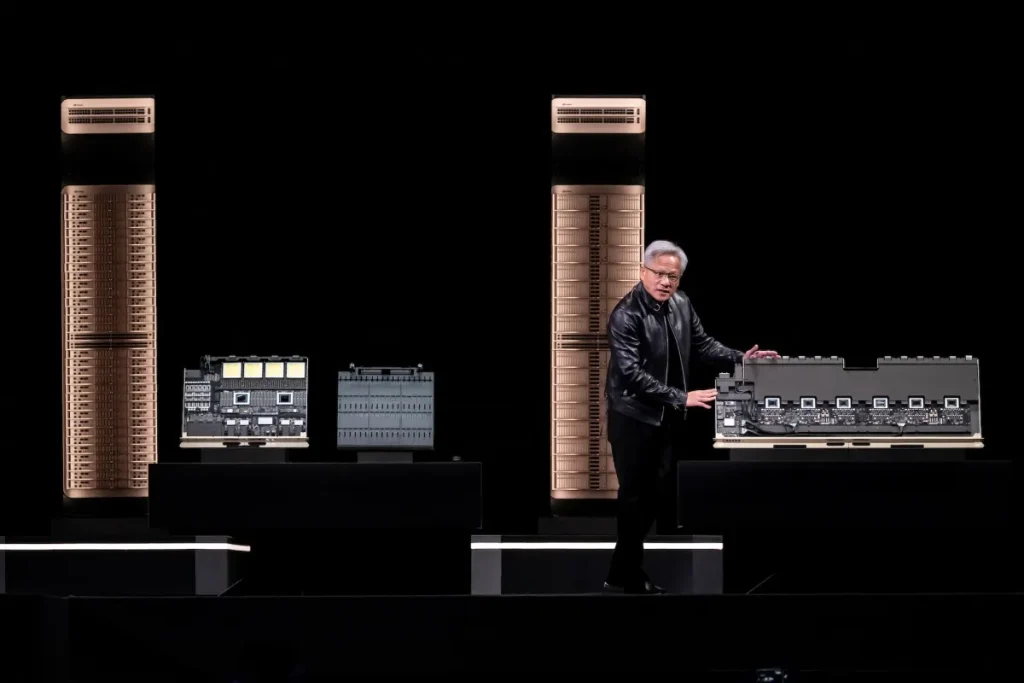
Image Credits:David Paul Morris/Bloomberg / Getty Images
Nvidia’s Evolving Narrative: Beyond GPUs
Before this week, the prevailing narrative surrounding Nvidia was clear: during the early stages of the AI boom, Nvidia stood as the sole provider of cutting-edge GPUs, reaping significant profits as the industry expanded. Recently, however, tech giants like Amazon and Google have begun developing their own chips, raising questions among investors about the sustainability of Nvidia’s competitive edge.
This story is compelling, mostly true, and characterized by remarkable growth. Between the start of 2023 and mid-2025, Nvidia’s market capitalization surged tenfold. Nonetheless, for the past year, Nvidia shares have followed a more conservative path due to heightened competition in the GPU sector.
A New Perspective Post-Earnings
Following Nvidia’s latest earnings announcement, a new narrative has emerged. Investors are beginning to understand that Nvidia’s strengths extend far beyond GPU hardware. As the computational demands of AI escalate into gigawatt territories, orchestration has become increasingly complex. Unsurprisingly, Nvidia has developed much of the sophisticated hardware required to meet these demands, creating a substantial advantage in the surrounding systems, even as it faces stiff competition for GPUs.
Despite discussions about compute resources becoming mere commodities, operating a megascale data center with peak efficiency remains an arduous challenge—one that is exacerbated as deployments grow larger and faster.
Understanding Nvidia’s Vera Rubin Architecture
The advancements in Nvidia’s offerings are particularly evident in their current rollout of the Vera Rubin architecture. This innovative framework integrates the Rubin GPU with complementary units, including the Vera CPU, Groq 3 LPX inference accelerator, and supportive storage and networking racks.
In discussions with Nvidia specialists, I learned that these systems, while highly specialized, focus on optimizing the performance of components outside the GPU. If the GPU functions as the engine of a car, these additional units represent the rest of the vehicle, ensuring everything works harmoniously.
The Vera CPU specifically addresses the orchestration of data flow. According to Jason Hardy, Nvidia’s VP of storage technology, “Vera is crucial because the memory capacity available in any single server or compute platform is limited.”
The Importance of Data Management
As data centers enhance their computational abilities, they also need to scale up memory capacity. This growth has led to the success of companies like Micron, who have profited significantly in this second wave of infrastructure development. However, efficiently transmitting data to the GPU at the right moment is complex. As companies strive to improve tokens-per-watt ratios, effective traffic management has become increasingly vital.
“We observed up to a 3x improvement in operational efficiency where the Vera CPU facilitates acceleration,” said Hardy. “Now we can fully utilize our flash storage’s potential without creating a bottleneck.”
Lessons from OpenAI’s Jalapeño Chip
Similar challenges exist outside of Nvidia. OpenAI’s development of the Jalapeño chip illustrates an alternative approach designed to circumvent these issues by minimizing data movement. As stated in a recent blog post, “We designed Jalapeño to minimize data movement and communication delays. Its large domain allows the entire workload to remain within one connected system, enhancing both speed and efficiency.”
This method deviates from the traditional reliance on efficient processors alone, advocating for integrated chips that conduct workloads without excessive data transfer. While the methodologies differ, the underlying principle remains consistent: enhancing efficiency through intelligent traffic management, rather than simply increasing the number of processor cycles, introduces a new competitive landscape.
A Shift in Competitive Dynamics
This renewed focus on data orchestration doesn’t guarantee success for Nvidia. The company is entering a competitive arena where it will vie against other chip manufacturers and hyperscalers, much like it has with GPUs. However, the competition is transitioning to a layer where the efficiency of the entire system holds more weight than merely producing rival GPUs.
In the initial stages of this development, Nvidia appears to be maintaining a commanding lead. Its robust architecture designed to orchestrate data and optimize the different components of its systems positions it strategically within the industry.
Conclusion: Nvidia’s Future in a Complex Landscape
Nvidia’s story is evolving from that of a standalone GPU supplier to a multifaceted player in the AI hardware ecosystem. As the demands of AI continue to grow, the importance of effective orchestration and system optimization becomes undeniable. Nvidia’s investments in specialized architectures like the Vera Rubin are shaping its trajectory in a landscape increasingly defined by complexity and efficiency.
While the challenge of competition looms large, Nvidia’s early advancements suggest that it is not just a contender in the GPU race but a pioneer in the broader systems that will underpin the future of AI.
As this narrative unfolds, investors and industry analysts will keenly watch how Nvidia adapts and thrives amid emerging competitors, and whether its lead can be translated into sustained success in the long term.
Thanks for reading. Please let us know your thoughts and ideas in the comment section down below.
Source link
#Nvidias #advantage #moving #GPU
About The Author