

Google’s Genie World Model Now Simulates Real Streets Using Street View Technology
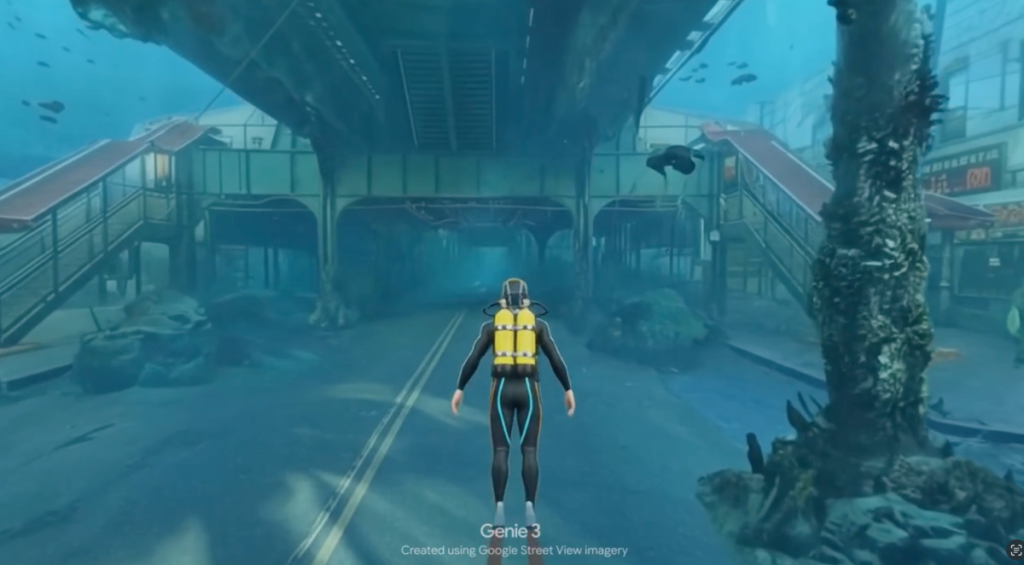
Image Credits:Google
Google DeepMind’s New Street View Integration: A Leap into Immersive Simulation
We’ve all used Google Maps’ Street View to take a stroll down memory lane, whether it’s showing a friend our childhood home or checking out a hotel’s neighborhood in Paris. However, what if we could enhance that experience? Imagine an interactive platform where you can fully simulate streets and surroundings, even altering the weather or visualizing environments in extreme scenarios—like those featured in “The Day After Tomorrow.” This is the vision behind Google’s latest development.
Introducing Project Genie
Starting today, Google DeepMind is linking Street View to Project Genie, a versatile world model designed for generating a range of diverse, interactive environments. This feature debuted during the Google I/O developer conference and aims to elevate how we interact with virtual spaces.
Jack Parker-Holder, a research scientist with DeepMind’s open-endedness team, emphasizes the tool’s dual significance: it’s not only useful for robotics and other agents but also for individual users. For instance, he describes a scenario where a new robot in London, which seldom sees sunlight, could experience simulated sunny days. This prevents abrupt adjustments for the robot, making it more efficient.
Simultaneously, users could plan hypothetical trips, like visiting snowy New York City, by visualizing how specific streets would appear in different weather conditions.
The Background of Street View Data
For 20 years, Google has meticulously gathered Street View data using vehicles outfitted with cameras and individuals equipped with “tracker backpacks.” The company has amassed over 280 billion images from 110 countries and all seven continents. The wealth of real-world data collected offers a unique springboard for creating immersive simulations.
Jack highlighted the importance of merging this extensive imagery with simulation technology. “Street View provides a vast resource of real-world visual data,” he remarked, suggesting that combining this data with simulation capabilities could yield highly effective tools for various applications.
Genie 3: Unlocking New Possibilities
Last August, Google introduced Genie 3 for research preview, granting Google AI Ultra subscribers in the U.S. access as of January. With Genie, users can create interactive game worlds based on text prompts or images, opening avenues for educational experiences, gaming, and even robotics training.
Genie 3 is already integral to Waymo’s simulators, which are used to train self-driving cars for rare events, such as tornadoes or elephant encounters. Incorporating Street View data into this framework could enable Waymo to expand its operations into more cities worldwide. Parker-Holder elucidated that while Waymo’s existing simulator operates from a vehicular perspective, Genie offers the flexibility of viewing scenarios through various agents, including humans and robots.
Rolling Out Street View Integration
Starting today, Google is rolling out Street View in Genie to a select group of Ultra users in the United States, with a phased global rollout planned over the coming weeks. Diego Rivas, a product manager at DeepMind, indicated that this capacity should become widely accessible. However, he noted that both Street View and Genie are still in experimental stages, with room for improvement, particularly in terms of accuracy.
Immersive Simulations: The Current State
The early samples showcased by Google present results that are recognizably impressive—though they retain a video game-like quality rather than reaching photorealistic standards. At this point, models lack understanding of physical laws, which impacts their realism. For instance, in a simulation of a woman running through a snowy Joshua Tree, she could pass through cacti and bushes without any consequences.
While some of Google’s other technology, like the image generator Nano Banana and the video generator Veo, exhibit advanced physics understanding, Genie’s models learn intuitively over time through observation, similar to living beings. Parker-Holder predicts that this model may be six to twelve months behind video technology in terms of accuracy and quality, but he believes these gaps will soon be closed.
The Future: Spatial Continuity and Beyond
Jonathan Herbert, director of Google Maps and a former intern on the Street View team, highlights the complexity of creating a true street reconstruction with Genie. He points out that the breakthrough lies in the AI’s capacity for spatial continuity; the system remembers the environment surrounding the user when they rotate 360 degrees, allowing for more intricate environmental simulations.
Herbert remarked, “We have long thought about how we can build out the best and richest model of the world on top of Street View data.” He emphasized that utilizing Maps data for innovative AI research has been a long-held ambition within the team.
Conclusion
The integration of Street View and Project Genie by Google DeepMind represents a significant advancement in the way we can interact with our world digitally. With the power to simulate environments, adjust variables like weather, and provide a more immersive experience, this technology could revolutionize how we explore our surroundings — both real and imagined. As developments continue, the hope is that these immersive simulations will find applications in everyday life, education, gaming, and robotics, paving the way for a fascinating future.
Whether you’re a tech enthusiast, an educator, or a gaming aficionado, the upcoming capabilities of Google’s Genie are sure to offer transformative experiences ahead.
Thanks for reading. Please let us know your thoughts and ideas in the comment section down below.
Source link
#Googles #Genie #world #model #simulate #real #streets #Street #View
About The Author