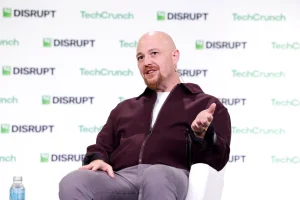

Neil Rimer believes AI investments are resurfacing.

Image Credits:Panathenea (opens in a new window) /
Neil Rimer’s Call for Wealth Redistribution
In late May, during an insightful conversation in Athens, Neil Rimer made a statement that has lingered in my mind. At a lively new tech festival, Rimer discussed the accumulating wealth from artificial intelligence (AI) and expressed his belief that a redistribution of that wealth is inevitable. He emphasized, “It’ll either be voluntary or it’ll be involuntary, but it’ll happen, and I hope it’s voluntary.” As a co-founder of Index Ventures, a highly regarded venture capital firm, his words carry weight in the tech world.
Rimer’s Journey and Philanthropy
Having stepped back from daily investing in 2021, Rimer now spends much of his time in Athens, where he engages deeply with local culture. His casual attire during our interview stood in contrast to the polished looks typical of his peers. Despite his low-key demeanor, Rimer’s firm has had notable success, raising approximately $15 billion since its inception. Last year alone, Index Ventures saw significant returns from high-profile exits, including Figma’s IPO and Google’s acquisition of the cybersecurity firm Wiz.
Rimer embodies a philanthropic spirit. He serves on the board of Endeavor Greece, which supports entrepreneurs in developing markets, and chaired Human Rights Watch from 2019 to 2025. In 2021, he, alongside family, donated $13 million to McGill University for campus renovations and the establishment of an Indigenous research institute.
The Changing Landscape of Philanthropy
Rimer’s comments on redistribution come at a perplexing time for philanthropy. The Giving Pledge—initiated by Warren Buffett and Bill Gates in 2010—has seen diminishing participation. While more than 100 families signed it in its early years, only four did so in 2024. This decline highlights a broader trend: The number of Americans donating to charity has decreased for five consecutive years, despite total charitable contributions hitting record levels at $592.5 billion in 2024.
A recent Business Insider article noted that many employees from Anthropic, a company backed by Index Ventures, are more focused on personal investments rather than philanthropy. Although Anthropic has a matching donation program, many employees prioritize entrepreneurial endeavors over charitable giving.
Legislative Responses to Wealth Inequality
Given the decline in voluntary contributions, discussions about wealth redistribution are surfacing through legislation. California voters are set to decide on a one-time 5% wealth tax targeting billionaires, prompting some tech moguls, including Google founders Sergey Brin and Larry Page, to relocate to more tax-friendly states.
Additionally, OpenAI may consider going public in 2027, potentially to circumvent the aforementioned tax. Such measures have sparked criticism, particularly from executives like California Governor Gavin Newsom and economists who cite the exodus of wealthy individuals from states with similar taxes in the past.
Controversial Proposals in Silicon Valley
There are controversial solutions being floated as well. Reports suggest OpenAI is contemplating granting the federal government a 5% equity stake, a move CEO Sam Altman frames as a fair distribution of AI’s benefits. However, critics view this as an attempt to gain political leverage. Historically, Silicon Valley has been wary of government involvement in the tech sphere.
The wealth generated by AI is considerable. Elon Musk’s recent achievement of a $1 trillion net worth, alongside 45 new AI billionaires amounting to $2.9 trillion, underscores the financial surge in the tech sector. Analysts predict that once companies like Anthropic and OpenAI go public, their collective employees could acquire nearly a third of all homes in the San Francisco metro area.
Historical Context of Wealth Concentration
The concentration of wealth today is reminiscent of previous economic eras in America. While the top 1% held 31.7% of total household wealth in 2023—a historical high—the comparisons with the Gilded Age offer perspective. In 1910, the wealth of America’s four richest families accounted for about 4% of GDP; today, the wealth of a similar bracket—19 households—encompasses 14% of GDP.
Rimer’s notion of redistribution invokes historical precedents. In 1889, Andrew Carnegie advocated for the wealthy to treat their fortunes as trusts for public good, a view crystallized in his essay “The Gospel of Wealth.” This essay laid the ideological groundwork for modern philanthropy and initiatives like the Giving Pledge.
Conversely, the 1930s saw Louisiana Senator Huey Long championing “Share Our Wealth,” calling for steep taxes on the wealthy to ensure a guaranteed income for all Americans. Franklin Roosevelt responded to Long’s popularity by implementing high marginal tax rates under the moniker “soak-the-rich tax.” This marked a clear shift toward politically enforced redistribution when voluntary measures fell short.
The Current Moral Obligation
Rimer is acutely aware of these historical cycles. He reflects on the moral center of tech companies with concern. His views have shifted from seeing figures like Steve Jobs as heroes to hearing his own children discuss tech companies in negative terms akin to past perceptions of tobacco and defense industries.
While some may argue Rimer, as an investor in AI companies, is benefitting from the wealth he discusses needing redistribution, he advocates for voluntary giving over legislative measures. He believes an easy route exists for beneficiaries to contribute back to society, and he hopes that they choose generosity before history compels a harsher course of action.
Rimer’s perspective emphasizes the evolving relationship between wealth, technology, and society. As the disparity continues to grow, leaders in the tech industry must consider their role in shaping a more equitable future.
Thanks for reading. Please let us know your thoughts and ideas in the comment section down below.
Source link
#Neil #Rimer #thinks #money #coming
About The Author