
AMD Challenges Nvidia with New Helios AI Rack-Scale System Launch
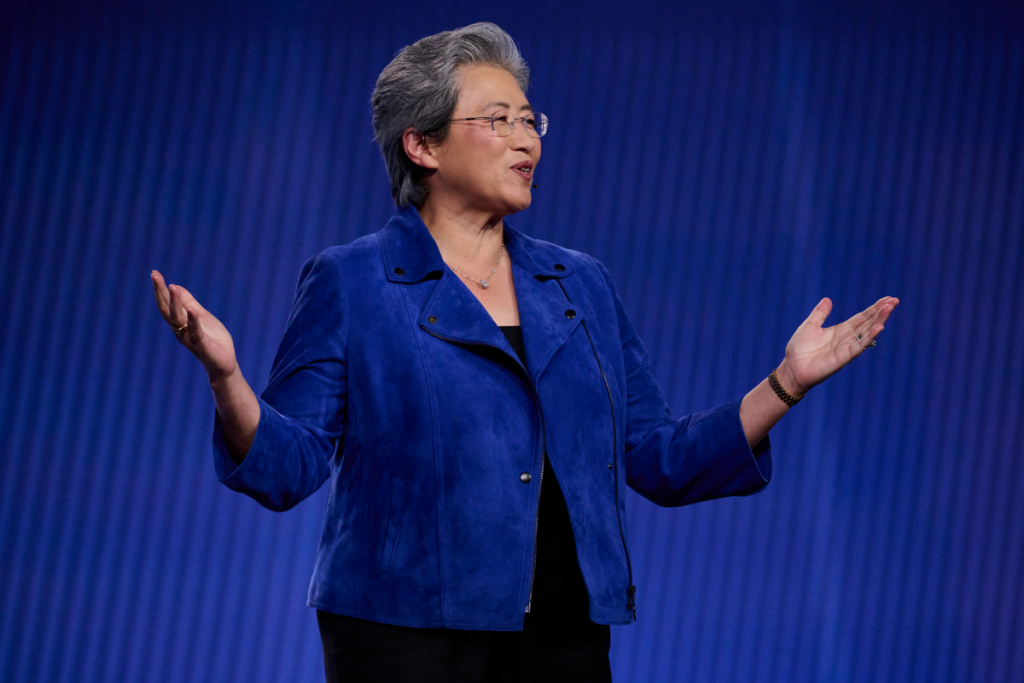
Image Credits:Bridget Bennett/Bloomberg via Getty Images
AMD Targets Nvidia with Innovative AI Rack System Helios
Chipmaker AMD is taking bold steps to compete with Nvidia through the launch of its latest hardware: Helios, a cutting-edge rack-scale system tailored to meet the computational demands of the world’s largest AI labs. This ambitious move was unveiled during the packed Advancing AI conference in San Francisco, where AMD Chair and CEO Dr. Lisa Su highlighted the new system’s capabilities and its growing roster of clients, including tech giant Microsoft, as the company gears up for shipment later this year.
What is Helios?
Helios represents a significant advancement in computing technology, effectively merging numerous processors into a powerful single unit designed for data centers. These rack systems play a crucial role in training and running AI models as well as other compute-intensive tasks. Dr. Su emphasized that Helios is the “highest-performance AI rack” in the tech industry, specifically engineered for handling the most demanding frontier models at a massive scale.
According to AMD, Helios will be deployed by top AI firms at gigawatt-scale, indicating its suitability for the most ambitious AI projects.
Competing with Nvidia
Historically, Nvidia has maintained a dominant position in the rack-scale system market, primarily through its Vera Rubin and Grace Blackwell systems. However, AMD’s Helios appears to offer competitive performance metrics, reportedly outperforming Nvidia’s Vera Rubin across various benchmarks, as stated by The Register.
This competitive landscape is changing, with AMD’s entry influencing market dynamics. Helios was first introduced in 2025 and showcased in January 2026 at CES. Alongside Microsoft, notable companies like OpenAI, Meta, Oracle, and Anthropic have already expressed their intentions to implement the Helios system. In a recent announcement, Microsoft CEO Satya Nadella indicated that the company plans to enhance its Azure infrastructure with the Helios system. Furthermore, AMD and Anthropic revealed a strategic partnership to deploy up to two gigawatts of GPUs through this new rack system.
Introducing the Venice-X CPU
In addition to Helios, AMD also launched its Venice-X CPU, a product designed specifically for data centers to manage high-computing workloads. The Venice-X CPU is anticipated to hit the market in 2027, showcasing AMD’s commitment to providing robust solutions for the evolving tech landscape.
The Future of AI Chips
During her keynote address, Dr. Su shared insights into the future trajectory of the chip industry. She predicted that by 2030, chips specifically designed to power AI applications will account for a substantial portion of the overall computing market. This anticipated shift comes as the industry experiences a “step change in compute demand,” primarily driven by the rise of agentic AI.
Dr. Su explained, “When you ask the agent to do something, it involves numerous steps that require reasoning, tool utilization, and data access, all of which must be repeated until the problem is solved.” This multifaceted process underscores the necessity for a large number of GPUs to efficiently manage these tasks.
Economic Implications
Looking ahead, Dr. Su projected that the AI accelerator market could reach approximately $1.4 trillion by 2030, which would mean that the size of this market might rival the entire semiconductor industry today. She added that, “We expect GPUs will constitute the majority of that market, as the algorithms are still in their infancy and workloads continue to evolve,” emphasizing that this evolution favors programmability across the broader silicon ecosystem.
Conclusion
AMD’s introduction of the Helios rack-scale system marks a pivotal moment for the company as it seeks to challenge Nvidia’s stronghold in the AI market. With a growing list of high-profile customers and the unveiling of the Venice-X CPU, AMD appears poised for significant growth in the coming years. The projection of a $1.4 trillion AI accelerator market by 2030 further underscores the urgency and importance of innovation in this space. As the demand for advanced AI capabilities continues to rise, AMD’s strategic moves position it well for future opportunities and challenges.
Thanks for reading. Please let us know your thoughts and ideas in the comment section down below.
Source link
#AMD #takes #Nvidia #Helios #rackscale #system
About The Author